INSPIRATION AND THE ELLEN G. WHITE
WRITINGS
A Reprint of Articles Published in the Adventist
Review
By ARTHUR L. WHITE
Arthur L. White has worked with the Ellen G.
White trustees since 1929, first as secretary to William C. White for four
years, next as assistant secretary to the Ellen G. White Estate for four years,
and then as secretary of the Estate for 41 years. He is now writing a comprehensive
biography of Ellen White, as well as continuing as a lifetime trustee of the
Ellen G. White Estate.
[Written in 1979]
Two groups of articles published
in the Adventist Review are reproduced in this reprint--the first,
a series of four articles published under the title "Toward an Adventist Concept
of Inspiration," appeared in issues dated January 12, 19, 26, and February
2, 1978; the second series, published under the title "The Ellen G. White
Historical Writings," appeared in the issues of July 12, 19, 26 and August
2, 9, 16, and 23, 1979.
Accompanying the articles is a statement by
the former editor of the Review, Kenneth H. Wood. The statement has
been adapted from an editorial published originally with the second series
of articles.
-
Toward an Adventist concept of inspiration
-
- Visions and bearing testimony
- How the light came to Ellen White
- Symbolic representations given
-
Toward an Adventist concept of inspiration
-
- Guidance of the Holy Spirit
- Writing history
- Observations of W. C. White
- Sometimes gave partial descriptions
-
Toward an Adventist concept of inspiration
-
- The prophet's manuscripts
- An editorial explains
-
Toward an Adventist concept of inspiration
-
- How God got His message through
-
The Ellen G. White historical writings
-
- The Influence of the Holy Spirit
- How the Information came to her
- Scenes witnessed in vision
-
The Ellen G.White historical writings
-
- The Testimony of W. C. White
- Books for door-to-door sales
- Interest in Reformation
History
-
-
- The Huss Manuscript
- Sketeches from the Life of Paul
- Building material in the prophets's hands
- Contain instruction God has given
-
The Ellen G. White historical writings
-
- Confident in both human and divine
help
- Points unique to Ellen White
-
The Ellen G. White historical writings
-
- A course on the life of Christ
- Titles for books and chapters
-
-
- Was Ellen White dependent upon other authors?
- Thief on the cross story detailed
-
The Ellen G.White historical writings
-
- Different and dramatic
- A personal testimony
Some subjects are of special interest to
spiritually-minded people. One of these is inspiration/revelation--how God, an
infinite, transcendent Being, communicates with His earthly children.
The Adventist Review in two series of
articles from the pen of Arthur L. White has brought to the attention of
Seventh-day Adventists certain phases of this important subject. The first, a
series of four articles titled "Toward an Adventist Concept of Inspiration,"
was published in January and February, 1978, and the second, a series of seven,
was published in July and August, 1979, under the title "Ellen G. White's
Sources for the Conflict Series Books."
Because of the intense current interest in
these matters, and to make these articles available for continued study, the
two series of articles have been brought together in this reprint.
In the 1978 series, Elder White, then
secretary of the Ellen G. White Estate, has written from decades of firsthand
experience in working with inspired documents. In these four articles he
clarifies some of the concepts necessary for a better understanding of how
inspiration operates.
In the second series of seven articles, he
takes us behind the scenes to show how Ellen White worked in preparing the
books that present the great controversy story, and provides new, carefully
documented information and insights on some aspects of the working of
inspiration in the experience of Ellen G. White as she prepared her historical
writings. We believe that every reader, no matter how well informed on the way
inspiration works, will learn something from these articles.
Not all the material is new, of course. The
elements that are repeated are included chiefly for two reasons--to present a
balanced picture and to provide information that readers may have missed in
previously published books and Review articles.
Four facts should, perhaps, be kept clearly
in mind as one reads these articles.
1. Inspired writings do not come to
us "untouched by human hands." They are not written by God and handed to us
as were the Ten Commandments on Mount Sinai. In communicating God's messages to
the human family, the inspired writer involves himself in much hard labor.
Unless God gives him specific words, as He does sometimes in visions when the
prophet hears heavenly beings speaking, he must find for himself the words that
set forth accurately the truths God has revealed to him. In this process he may
draw upon his own vocabulary, find words in a dictionary or thesaurus, borrow
expressions from the writings of uninspired writers, or be aided by assistants.
"Inspiration acts not on the man's words or his expressions but on the man
himself, who, under the influence of the Holy Ghost, is imbued with thoughts.
But the words receive the impress of the individual mind."-- Selected
Messages, book 1, p. 21.
People seldom think of this when they read
the Bible or the writings of Ellen G. White. They tend to think that literary
works containing inspired messages were created ex nihilo, somewhat as
was the world during Creation week. (Some people also think of the Review as
originating in this way. They forget the work of authors, editors, typesetters,
proofreaders, pressmen, computer operators, mailers, and a host of others who
were involved in producing and delivering the magazine.)
We think Elder White's series of articles
will be particularly helpful in that it will provide a behind- the-scenes
glimpse of how Ellen G. White wrote her books and how they were prepared for
publication.
2. In communicating with the human
family, God inspired persons, not writings. Inspiration acted on the
person, not on literary products. The apostle Peter declared: "Holy men of God
spake as they were moved by the Holy Ghost" (2 Peter 1:21). "It is not the
words of the Bible that are inspired, but the men that were
inspired."--Ibid. This is an important point, and it must not be
misunderstood. Speakers and others often call the Bible "the inspired Word of
God"; and rightly so. Mrs. White's statement refers to methodology, not
authority. God inspires people, not words. People can think; works cannot.
People can be impressed by the Holy Spirit; words cannot.
3. Inspiration involves a variety of
methods in communicating truth and God's will. Some Bible writers were
given visions and dreams. Others, who had no visions, were given special
understandings and insights into divine mysteries. Others were given special
guidance in selecting and recording events and historical incidents. Still
others were given special wisdom in understanding and interpreting the meaning
of events. On the latter point it is well to note that historical events may be
observed and recorded by both inspired people and uninspired people. Numerous
writers could have recorded the fact that three men were crucified on a Friday
in A. D. 31. But without an inspired person to provide the meaning of the
event, the happening would have been seen as little different from numerous
other crucifixions. One of the major functions of inspiration is to enable
people to see the meaning of events, and to interpret them in the light of the
great controversy between Christ and Satan.
4. The message of an inspired writer does
no depend for its authority on whether it is accompanied by the label, "This is
God's Word." In Old Testament times the prophets often began or ended their
messages with statements such as "The Lord spake thus," "The word of the Lord
came unto me," "The Lord said," or "The Lord hath spoken it" (see, for example,
Isa. 1:24; 8:11; Eze. 6:1; Hosea 1:2; Obadiah 18). New Testament writers, while
at times mentioning the origin of their messages (e. g., Rev. 1:1, 2), usually
did not. They depended on the writings to be self-authenticating as messages
from God. In her earlier writings, Mrs. White often used the expression "I was
shown," but later, especially when writing for the general public, she did not.
This change of practice did not indicate any difference in the authority of the
message communicated.
If kept in mind, the four points that we have
mentioned will aid in understanding and appreciating the information set forth
by Elder White in this compilation of Review articles. The articles represent
the mature thinking and experience of one who has spent 50 years gaining
increased familiarity with documents given through inspiration, and studying
how Ellen G. White, his inspired grandmother, did her work.
In 1890 Mrs. White wrote: "The very last
deception of Satan will be to make of none effect the testimony of the Spirit
of God. . . . Satan will work ingeniously, in different ways and through
different agencies, to unsettle the confidence of God's remnant people in the
true testimony."-- Letter 12, 1890, quoted in Selected Messages, book 1,
p. 48.
Because Satan is today making supreme
efforts to undermine confidence in the writings of the Spirit of Prophecy, we
feel convinced that the end of all things is near. Now is the time for us to
build faith and know what we believe. This series of articles should strengthen
confidence in God, His church, and His inspired messenger.
Kenneth H. Wood
Page 3
Toward an Adventist concept of inspiration - 1
How do Seventh-day Adventists understand inspiration? Is the Seventh-day
Adventist concept different from concepts commonly held?
In several aspects the Adventist concept is different. It partakes neither
of the modernistic, liberal views that destroy the authority of God's Word nor
the ultraconservative views that make the prophet a mere automaton'a machine,
as it were'speaking or writing words he is impelled to utter or to record.
As Seventh-day Adventists we are uniquely fortunate in approaching this
question. We are not left to find our way, drawing our conclusions only from
writings penned 19 centuries and more ago, which have come down to us through
varied transcriptions and translations. Concerning inspiration, with us it is
an almost contemporary matter, for we have had a prophet in our midst.
What is more, rather than having in our possession only relatively short
documents or a handful of letters, as is the case with the extant records of
the Bible prophets, we have the full range of Ellen G. White writings penned
through a period of 70 years, embodying her published books, her 4,600
periodical articles, and her manuscripts, letters, and diaries. We have also
the testimonies of her contemporaries'eyewitness accounts of those who lived
and worked closely with her. Both she and they discussed many points touching
on the visions and on the manner in which the light was imparted to her, and
how she, in turn, conveyed the messages to those for whom they were intended.
In other words, the eyewitnesses discussed the operation of inspiration.
Further, she wrote in a modern language, so a large number of people today
can study her writings in the original language, without needing to depend on a
translation. Rarely, too, is it necessary to depend upon a transcription.
If we accept Ellen White as an honest witness, then her observations
concerning her work, her statements on inspiration, and her declaration as to
the work of the prophets of old are particularly significant to us. Thus what
she has said of the work of the prophet in action can well form a basis for
arriving at an accurate understanding of inspiration.
We shall discuss the subject as she did without resorting to theological
language or definitions.
First of all, we should note that when the Lord imparts light to the
prophets He does not confine Himself to one fixed procedure. "God . . . in
divers manners spake in time past unto the fathers by the prophets" (Heb. 1:1).
Therefore, one must not look for a uniform pattern that will govern all the
procedures in this matter of God's giving His messages to human instruments.
This is an important point.
Second, the prophet is a normal human being with all the faculties possessed
by such a being. He sees, hears, smells, meditates, reads, eats, sleeps,
worships, speaks, and travels, as do other people. At the time of his call to
the prophetic office he may or may not be well informed in some lines of
knowledge. All through his life subsequent to his call to the prophetic office,
he continues to gain information in most matters in the same manner in which we
all obtain such information. Being called to the prophetic office does not blot
from his mind information gained in past experiences, nor does it block his
mental faculties from continuing to obtain information as he did before his
call to the prophetic office.
Being called in a unique manner to the service of the
Page 4
Lord as a prophet, he is in a position to receive special information from
God. This may be in the fields of theology and religious experience. It may be
in the field of history, recounting the special guidance of God for His people
or for individuals, or warning of the perils incident to Satan's determination
to destroy the work of God or the hope of souls. It may be in the field of
physiology, nutrition, or hygiene. It may be in the realm of eschatology. It
may be in the field of education or church administration. It may be in the
revealing of hidden sins.
The fields in which information may be imparted are without limit, for the
work is in God's hands. This experience is uniquely that of the prophet.
Although the Spirit of God may speak to the hearts of all consecrated persons,
not all are or can be prophets. God alone selects the prophet. "Holy men of God
spake as they were moved by the Holy Ghost" (2 Peter 1:21).
A prophet may receive visions during the day, accompanied by certain
physical phenomena (see Dan. 10), or in the night season, in a prophetic dream
(see Dan. 7). After the vision the prophet imparts to others what was intended
for them, either orally, in interviews, or in writing.
Thus there are two elements or procedures: "There is the receiving of the
information and the bearing of testimony--the presentation by the prophet of
the message, the light, the information--he received from the Holy Spirit.
He may not be at liberty to impart at once some of the information he
receives. Perhaps it is to be held until certain developments have taken place;
or perhaps the light is given fully to orient the prophet, but he is not at
liberty to disclose all that is revealed to him.
His mind thus becomes a reservoir or "bank," as it were, from which, when
circumstances demand, he is ready to speak forth. Often there is immediate need
for the message.
How the Light Came to Ellen White
Note the simplicity of the language used by Ellen White in a description of
how light came to her in her first vision: "While I was praying at the family
altar, the Holy Ghost fell upon me, and I seemed to be rising higher and
higher, far above the dark world. I turned to look for the Advent people in the
world, but could not find them, when a voice said to me, 'Look again, and look
a little higher. At this I raised my eyes, and saw a straight and narrow path,
cast up high above the world. On this path the Advent people were traveling to
the city, which was at the farther end of the path."--Early Writings, p.
14.
Analyzing this statement, we observe that her coming into vision is
described by the words "The Holy Ghost fell upon me." Although she remained
bodily in the room where she was praying at the family altar, to her it seemed
that'
1. She was rising above the world.
2. She turned to look for something.
3. She could not locate that which she sought.
4. She heard a voice speaking to her.
5. She obeyed the command of that voice.
6. Raising her eyes, she observed the Advent people traveling.
7. She viewed their destination.
8. Later, she seemed to be with them as they enjoyed their reward.
Thus it is clear that to her the experiences in vision were real. She was
seeing, feeling, hearing, obeying, and acting in faraway places, though bodily
she remained in the room. Those in the room with her did not see what she saw
or hear what she heard. It was more than a moving picture: she was a
participant in the action. Later she related or wrote out in her own words
these experiences.
Oftentimes while in vision Ellen White would be conveyed to a home or an
institution, and then she would be conducted from room to room or department to
department
Page 5
She would seem to be in the councils that were held, would witness the
actions of council members, hear the words spoken, and observe the surroundings
in general.
As Seventh-day Adventists we are uniquely fortunate in a study of
inspiration, for we have had a prophet in our midst.
In 1887, from across the Atlantic, she wrote to one of the workers regarding
the detrimental policies pursued in one of the institutions. Note how she
received her information: "I arose at three o'clock this morning with a burden
on my mind. . . . In my dreams I was at '', and I was told by my Guide to mark
everything I heard and to observe everything I saw. I was in a retired place,
where I could not be seen, but could see all that went on in the room. Persons
were settling accounts with you, and I heard them remonstrating with you in
regard to the large sum charged for board and room and treatment. I heard you
with firm, decided voice refuse to lower the charge. I was astonished to see
that the charge was so high."--Letter 30, 1887.
At times she was shown buildings not yet erected but which in the future
would constitute a part of institutions. She referred to one such instance in a
letter written in 1903: "I have been thinking of how, after we began sanitarium
work in Battle Creek, sanitarium buildings all ready for occupation were shown
to me in vision. The Lord instructed me as to the way in which the work in
these buildings should be conducted in order for it to exert a saving influence
on the patients.
"All this seemed very real to me, but when I awoke, I found that the work
was yet to be done, that there were no buildings erected.
"Another time I was shown a large building going up on the site on which the
Battle Creek Sanitarium was afterward erected. The brethren were in great
perplexity as to who should take charge of the work. I wept sorely. One of
authority stood up among us, and said, 'Not yet. You are not ready to invest
means in that building, or to plan for its future management.'
"At this time the foundation of the Sanitarium had been laid. But we needed
to learn the lesson of waiting."--Letter 135, 1903.
Two consecutive paragraphs from a personal testimony addressed to a
prominent worker of earlier years illustrate how life's experiences were
sometimes represented symbolically: "Many other scenes connected with your case
have been presented to me. At one time you were represented to me as trying to
push a long car up a steep ascent. But this car, instead of going up the hill
kept running down. This car represented the food business as a commercial
enterprise, which has been carried forward in a way that God does not commend.
"At another time you were represented to me as a general, mounted on a
horse, and carrying a banner. One came and took out of your hand the banner
bearing the words, 'The commandments of God, and the faith of Jesus,' and it
was trampled in the dust. I saw you surrounded by men who were linking you up
with the world."--Letter 239, 1903.
At times the events of the past, present, and future were opened up to Ellen
White in panoramic view. It seemed to her that she witnessed in rapid
succession the vivid enactment of the scenes of history. I quote here a few
sentences from her Introduction to
The Great
Controversy, giving us a glimpse of this means of enlightenment of her
mind: "As the Spirit of God has opened to my mind the great truths of His word,
and the scenes of the past and the future, I have been bidden to make
known to others that which has thus been revealed'to trace the history of the
controversy in past ages, and especially so to present it as to shed a light on
the fast-approaching struggle of the future."--Page xi. (Italics supplied.)
Page 6
The Holy Spirit is operative not only when the prophet receives
the divine message but also when he delivers the message in writing.
There are two features in the prophet's experience--the vision itself and
the bearing of testimony of what has been revealed in vision. Having been
received, the message must be imparted by the prophet through the most accurate
language at the prophet's command.
The prophet may have at ready command words that would convey the message
satisfactorily, or he may find it necessary to study diligently to find words
adequate to convey the message correctly and impressively. At one time he may
use certain words and at another time other words in conveying the same
message. While writing The Desire of
Ages, Mrs. White declared: "I tremble for fear lest I shall belittle
the great plan of salvation by cheap words. "-- Messenger to the
Remnant, p. 59. The transmission of the message might suffer some
impairment because of the inadequacy of human language. Note this comment by
Ellen G. White:
"The Bible . . . was written by human hands; and in the varied style of its
different books it presents the characteristics of the several writers. The
truths revealed are all 'given by inspiration of God' (2 Tim. 3:16); yet they
are expressed in the words of men. The Infinite One
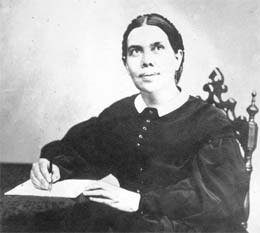
Ellen White said that she was just as dependent upon the
Spirit of the Lord
in relating or writing out her visions as she was in having them. [Click
to Enlarge] by His Holy Spirit has shed light into the minds and hearts of His
servants. He has given dreams and visions, symbols and figures; and those to
whom the truth was thus revealed have themselves embodied the thought in human
language. . .
Page 7
"Written in different ages, by men who differed widely in rank and
occupation, and in mental and spiritual endowments, the books of the Bible
present a wide contrast in style, as well as a diversity in the nature of the
subjects unfolded. Different forms of expression are employed by different
writers; often the same truth is more strikingly presented by one than by
another. . . .
"As presented through different individuals, the truth is brought out in its
varied aspects. One writer is more strongly impressed with one phase of the
subject; he grasps those points that harmonize with his experience or with his
power of perception and appreciation; another seizes upon a different phase;
and each, under the guidance of the Holy Spirit, presents what is most forcibly
impressed upon his own mind'a different aspect of the truth in each, but a
perfect harmony through all. And the truths thus revealed unite to form a
perfect whole, adapted to meet the wants of men in all the circumstances and
experiences of life. "-- The Great
Controversy, pp. v, vi.
"Although I am as dependent upon the Spirit of the Lord in writing my views
as I am in receiving them, yet the words I employ in describing what I have
seen are my own, unless they be those spoken to me by an angel, which I always
enclose in marks of quotation."
Note the expression "Each, under the guidance of the Holy Spirit, presents
what is most forcibly impressed upon his own mind." Although the prophet must
draw upon his facilities of expression in presenting his message, the Holy
Spirit is at work. This is a vital point. Ellen White put it this way:
"Although I am as dependent upon the Spirit of the Lord in writing my views as
I am in receiving them, yet the words I employ in describing what I have seen
are my own, unless they be those spoken to me by an angel, which I always
enclose in marks of quotation. "--Selected Messages, book 1, p. 37.
Guidance of the Holy Spirit
In answering certain questions in 1860, she also touched on this point:
"Sometimes the things which I have seen are hid from me after I come out of
vision, and I cannot call them to mind until I am brought before a company
where that vision applies, then the things which I have seen come to my mind
with force. I am just as dependent upon the Spirit of the Lord in relating or
writing a vision, as in having the vision. It is impossible for me to call up
things which have been shown me unless the Lord brings them before me at the
time that He is pleased to have me relate or write them."--Ibid., pp.
36, 37.
The thought is again emphasized: "Through the inspiration of His Spirit the
Lord gave His apostles truth, to be expressed according to the development of
their minds by the Holy Spirit. But the mind is not cramped, as if forced into
a certain mold."--Ibid., p. 22.
The prophet, then, receives his message through the visions while totally
under the influence of the Spirit of God. He bears his testimony under the
influence of the Spirit of God, but not to the point of being mechanically
controlled, or of being forced into a mold. Rather, he communicates the message
in the best manner and from the point of view of his background and style, thus
appealing particularly to people with backgrounds similar to his.
On certain occasions the very words to be used are impressed upon his mind
by the Spirit of God. Note this from Ellen White in a letter of admonition in
which after dealing with certain situations she stated: "I am trying to catch
the very words and expressions that were made in reference to this matter, and
as my pen hesitates a moment, the appropriate words come to my mind."'Quoted in
Ellen G. White Writings, p. 22.
Another statement reads: "While I am writing out important matter, He [the
Holy Spirit] is beside me, helping me .... and when I am puzzled for a fit word
with which to express my thought, He brings it clearly and distinctly to my
mind. "--Letter 127, 1902.
History was presented to Ellen White as a background on which the great
controversy story was traced. In her introduction to The Great
Controversy she tells how the controversy was presented to her: "Through
the illumination of the Holy Spirit, the scenes of the long-continued conflict
between good and evil have been opened to the writer of these pages. From time
to time I have been permitted to behold the working, in different ages, of the
great controversy between Christ, the Prince of life, and the Author of our
salvation, and Satan, the prince of evil, the author of sin, the first
transgressor of God's holy law. "--Page x.
It appears that her experience was similar to that of Moses on Mount Nebo
when the Promised Land was shown him. Ellen White describes Moses' experience
vividly in Patriarchs and Prophets: "And now a panoramic view of the
Land of Promise was presented to him. Every part of the country was spread out
before him, not faint and uncertain in the dim distance, but standing out
clear, distinct, and beautiful to his delighted vision. In this scene it was
presented, not as it then appeared, but as it would become, with God's blessing
upon it, in the possession of Israel.
"He seemed to be looking upon a second Eden. There were mountains clothed
with cedars of Lebanon, hills gray with olives and fragrant with the odor of
the vine, wide green plains bright with flowers and rich in fruitfulness, here
the palm trees of the tropics, there waving fields of wheat and barley, sunny
valleys musical with
Page 8
the ripple of brooks and the song of birds, goodly cities and fair gardens,
lakes rich in 'the abundance of the seas,' grazing flocks upon the hillsides,
and even amid the rocks the wild bee's hoarded treasures. . . .
"Moses saw the chosen people established in Canaan, each of the tribes in
its own possession. He had a view of their history after the settlement of the
Promised Land: The long, sad story of their apostasy and its punishment was
spread out before him. He saw them, because of their sins, dispersed among the
heathen, the glory departed from Israel, her beautiful city in ruins, and her
people captives in strange lands. He saw them restored to the land of their
fathers, and at last brought under the dominion of Rome.
"He was permitted to look down the stream of time and behold the first
advent of our Saviour. . . . He followed the Saviour to Gethsemane, and beheld
the agony in the garden, the betrayal, the mockery and scourging--the
crucifixion. . . . He looked again, and beheld Him coming forth a conqueror,
and ascending to heaven escorted by adoring angels and leading a multitude of
captives."---Pages 472--476.
The dramatic picture continues, but we need go no further. Enthralled, Moses
watched the events take place, seeing, hearing, and participating, and in
receiving the message even the sense of smell came into play. In this vivid
manner the history of the future was opened up to the prophet. It is very
unlikely that dates were revealed to him. It is not likely that all the cities
he saw were named. Those were inconsequential details, not of primary
importance to the unfolding theme.
Was Ellen White shown in each instance in minute detail all of the names of
the places and the dates of the events which she beheld? The evidence is that
she was not.
She saw events occur--events significant as a part of the controversy story.
Minor details and incidental references not basic to the account were of less
importance. Some of this information could be ascertained from the sacred
writings, some from common sources of knowledge, such as reliable historians.
Apparently in His providence God did not consider it essential to impart these
minutiae through vision.
Ellen White's son, W. C. White, describes her experience as follows: "Mother
has never claimed to be authority on history. The things which she has written
out are descriptions of flashlight pictures and other representations given her
regarding the actions of men, and the influence of these actions upon the work
of God for the salvation of men, with views of the past, present, and future
history in its relation to this work. In connection with the writing out of
these views, she has made use of good and clear historical statements to help
make plain to the reader the things which she is endeavoring to present.
"When I was a mere boy, I heard her read D'Aubigne's History of the
Reformation to my father. She read to him a large part, if not the whole,
of the five volumes. She has read other histories of the Reformation. This has
helped her to locate and describe many of the events and the movements
presented to her in vision. This is somewhat similar to the way in which the
study of the Bible helps her to locate and describe the many figurative
representations given to her regarding the development of the great controversy
in our day between truth and error."--W. C. White in a statement in the General
Conference Council, Oct. 30, 1911, quoted in Ellen G. White Writings, p.
33.
A few months later W. C. White stated the following: "Regarding Mother's
writings and their use as authority on points of history and chronology, Mother
has never wished our brethren to treat them as authority regarding the details
of history or historical dates. The great truths revealed to Mother regarding
the controversy between good and evil, light and darkness, have been given to
her in various ways, but chiefly as flashlight views of great events in the
lives of individuals and in the experiences of churches, of bands of reformers,
and of nations. . . .
"When writing out the experiences of reformers in the time of the
Reformation and in the great Advent Movement of 1844, Mother often gave at
first a partial description of some scene presented to her. Later on she would
write it out more fully,and again still more fully. I have known her to write
upon one subject four or five times, and then mourn because she could not
command language to describe the matter more perfectly.
Sometimes Gave Partial Descriptions
"When writing out the chapters for Great Controversy, she sometimes
gave a partial description of an important historical event, and when her
copyist who was preparing the manuscripts for the printer, made inquiry
regarding the time and place, Mother would say that those things are recorded
by conscientious historians. Let the dates used by those historians be
inserted.
"When Controversy was written, Mother never thought that the readers
would take it as authority on historical dates or use it to settle controversy
regarding details of history, and she does not now feel that it should be used
in that way. Mother regards with great respect the work of those faithful
historians who devoted years of time to the study of God's great plan as
presented in the prophecy, and the outworking of that plan as recorded in
history."--W. C. White, Letter to W. W. Eastman, Nov. 4, 1912.
With regard to the history of the Reformation the following statement by
Ellen White is significant: "Events in the history of the reformers have been
presented before me. "--Letter 48, 1894.
Related to this is W. C. White's declaration that: "Mother's contact with
European people brought to her mind scores of things that had been presented to
her during past years, some of them two or three times, and other scenes many
times."--Quoted in The Ellen G. White Writings, p. 124.
Page 9
The autograph copies of the Biblical writers have long since
disappeared. But Ellen White's autograph manuscripts are extant and throw light
on the method of inspiration.
Ellen White declares of the Bible: "The Holy Scriptures are to be accepted
as an authoritative, infallible revelation of His will. . . . 'Every scripture
inspired of God is also profitable for teaching, for reproof.' "--The Great
Controversy, p. vii.
She does not deny that the wording of the Scriptures may lead some to draw
fallible conclusions. But she affirms that the Scriptures themselves provide an
infallible revelation. The revelation of God's will is authoritative and
infallible, but the language used in imparting it to mankind is human and hence
is imperfect.
Declares Ellen White: "God and heaven alone are infallible."--Selected
Messages, book 1, p. 37. And again, in speaking of her work she says, "In
regard to infallibility, I never claimed it; God alone is
infallible."--Ibid. She illuminates this point, saying: "The Lord speaks
to human beings in imperfect speech, in order that the degenerate senses, the
dull, earthly perception, of earthly beings may comprehend His words. Thus is
shown God's condescension. He meets fallen human beings where they are. The
Bible, perfect as it is in its simplicity, does not answer to the great ideas
of God; for infinite ideas cannot be perfectly embodied in finite vehicles of
thought. Instead of the expressions of the Bible being exaggerated, as many
people suppose, the strong expressions break down before the magnificence of
the thought, though the penman selected the most expressive language through
which to convey the truths of higher education."--Ibid., p. 22.
We do not know, of course, the steps taken by the prophets of old in
preparing their manuscripts. Did they cross out a word or a phrase and replace
it with one that expressed the concept more clearly? Was the grammar in the
first draft faultless? Did the initial draft furnish copy ready for
publication? No copies of the original Bible manuscripts are extant for our
examination.
But when it comes to Ellen White, we have in our possession her own original
autographs. These give us clues. The fact that the Holy Spirit rested upon her
did not at once put her in possession of a knowledge of the correct spelling of
each word employed or of impeccable grammar. She was a careful worker and,
aided by God's Spirit, she possessed the ability to convey truth clearly and
impressively; but with her it required constant effort to do so as accurately
and effectively as possible. An examination of her published writings and of
her manuscripts reveals a progressive development in vocabulary and skill in
the use of words.
The recognition by her contemporaries of the fact that grammatical
imperfections could appear in inspired writings in no way lessened their
confidence in, or acceptance of, these writings.
Ellen White freely discussed the help she received from literary assistants:
"While my husband lived, he acted as a helper and counselor in the sending out
of the messages that were given to me. We traveled extensively. Sometimes light
would be given to me in the night season, sometimes in the daytime before large
congregations. The instruction I received in vision was faithfully written out
by me, as I had time and strength for the work. Afterward we examined the
matter together, my husband correcting grammatical errors and eliminating
needless repetition. Then it was carefully copied for the persons addressed, or
for the printer.
"As the work grew, others assisted me in the preparation of matter for
publication. After my husband's death, faithful helpers joined me, who labored
untiringly in the work of copying the testimonies and preparing articles for
publication.
"But the reports that are circulated, that any of my helpers are permitted
to add matter or change the meaning of the messages I write out, are not
true."--Selected Messages, book 1, p. 50.
These helpers were not baffled to find disagreement in tenses in a sentence
in a manuscript or an early pamphlet. Her ministry bore the divine credentials.
They knew the content of the messages to be God's message to them.
When in 1883 it became necessary to republish the early testimony pamphlets,
Mrs. White and her associates recognized that certain imperfections in
expression should be corrected so as to present the message in the best
literary form.
Because of its importance, the matter was carried to the General Conference
session of 1883. At that meeting, important decisions were reached that not
only gave guidelines for the reprinting of these "Testimonies" but also placed
the denomination on record as to its understanding of certain fundamental
principles having to do with the utterances of the Spirit of Prophecy. We quote
Page 10
from the minutes of the meeting:
"32. WHEREAS, Some of the bound volumes of the 'Testimonies to the Church,'
are out of print, so that full sets cannot be obtained at the Office; and
"WHEREAS, There is a constant and urgent call for the reprinting of these
volumes; therefore
"RESOLVED, That we recommend their republication in such a form as to make
four volumes of seven or eight hundred pages each.
"33. WHEREAS, Many of these testimonies were written under the most
unfavorable circumstances, the writer being too heavily pressed with anxiety
and labor to devote critical thought to the grammatical perfection of the
writings, and they were printed in such haste as to allow these imperfections
to pass uncorrected; and
"WHEREAS, We believe the light given by God to His servants is by the
enlightenment of the mind, thus imparting the thoughts, and not (except in rare
cases) the very words in which the ideas should be expressed; therefore
"RESOLVED, That in the republication of these volumes such verbal changes be
made as to remove the above-named imperfections, as far as possible, without in
any measure changing the thought; and, further
"34. RESOLVED, That this body appoint a committee of five to take charge of
the republication of these volumes according to the above preambles and
resolutions."--Review and Herald, Nov. 27, 1883.
Five years later in an editorial in the Review and Herald, Uriah
Smith discussed the question: "Which are inspired, Words or ideas?"
"The questioner says, 'Is not a word a sign of an idea? and how then can an
idea be inspired, and the signs that transfer the idea from one mind to another
be uninspired?'
"Ans.--If there was but one word by which an idea could be expressed, this
would be so; but when there are perhaps a hundred ways of expressing the same
idea, the case becomes very different. Of course, if the Holy Spirit should
give a person words to write, he would be obliged to use those very words,
without change; but when simply a scene or view is presented before a person,
and no language is given, he would be at liberty to describe it in his own
words, as might seem to him best to express the truth in the case.
"And if, having written it out once, a better way of expressing it should
occur to him, it would be perfectly legitimate for him to scratch out all he
had written and write it over again, keeping strictly to the ideas and facts
which had been shown him; and in the second writing there would be the divinely
communicated idea just as much as in the first, while in neither case could it
be said that the words employed were dictated by the Holy Spirit, but were left
to the judgment of the individual himself.
"Much of what the prophets have written in the Scriptures are words spoken
directly by the Lord, and are not their own words. In these cases, of course,
the words are inspired. In Sister White's writings she often records words
spoken by angels. Such words, of course, she gives as she hears them, and has
no discretionary power in regard to the terms to be used, or the construction
to be followed. These are not her words, and are not to be changed.
"But much of what the penmen of the Bible have said they might have written
in different phraseology, and the truths uttered have been inspired truths to
the same extent that they are now."--Review and Herald, March 13, 1888.
In a statement approved by Ellen White herself, W. C. White said:
"Mother has never laid claim to verbal inspiration, and I do not find that
my father, or Elders Bates, Andrews, Smith, or Waggoner put forth this claim.
If there was verbal inspiration in writing her manuscripts why should there be
on her part the work of addition or adaptation? It is a fact that Mother often
takes one of her manuscripts and goes over it thoughtfully, making additions
that develop the thought still further."--The Ellen G. White Writings,
p. 189.
"We believe the light given by God to His servants is by enlightenment of
the mind, thus imparting thoughts, and not . . . the very words in which the
ideas should be expressed."
This position is reaffirmed by words penned by Ellen White
while residing in Europe: "The Bible is written by inspired men, but it is not
God's mode of thought and expression. It is that of humanity. God, as a writer,
is not represented. Men will often say such an expression is not like God. But
God has not put Himself in words, in logic, in rhetoric, on trial in the Bible.
The writers of the Bible were God's penmen, not His pen. Look at the different
writers.
"It is not the words of the Bible that are inspired, but the men that were
inspired. Inspiration acts not on the man's words or his expressions but on the
man himself, who, under the influence of the Holy Ghost, is imbued with
thoughts. But the words receive the impress of the individual mind. The divine
mind is diffused. The divine mind and will is combined with the human mind and
will; thus the utterances of the man are the word of God."--Selected
Messages, book 1, p. 21.
Thus, because of the presence of a prophet of God in their midst,
Seventh-day Adventists have had a firsthand demonstration of how inspiration
operates. Those who work with the Biblical documents alone must deal with
materials written some two to three and a half millenniums ago, of which only
copies reproduced many times exist today.
Page 11
Certain crisis situations that loom ahead may be better weathered if sound
concepts of inspiration are held.
Faulty concepts concerning inspiration-revelation, be they liberal or
extreme, can lead to disaster. There is good reason to believe that the great
adversary will take advantage of unsound concepts in this area, for we are told
that "the very last deception of Satan will be to make of none effect the
testimony of the Spirit of God. 'Where there is no vision, the people perish.'
Satan will work ingeniously, in different ways and through different agencies,
to unsettle the confidence of God's remnant people in the true
testimony."--Selected Messages, book 1, p. 48.
One such effort was made some 60 years ago by a man who had
been a successful Seventh-day Adventist evangelist and an esteemed
administrator.1 As he turned critic and foe of the
church, he projected as a basis for his break with the church the allegation
that Ellen White and Adventists held that every line she wrote, whether in
articles, letters, testimonies or books, she claimed was dictated to her by the
Holy Spirit, and hence must be infallible.
Some years later a Bible teacher of my acquaintance who was working in a
Seventh-day Adventist college gave up his work and to a large extent lost his
confidence in the message. His problem? He could no longer accept Ellen White
as the Lord's messenger, and wrote a statement explaining why. His father had
served many years in the ministry of the church and held the Spirit of Prophecy
writings in high regard. In fact, he held what some might characterize as a
somewhat extreme position on inspiration, maintaining a mechanical dictational
concept. This concept he passed on to his son, who too became a minister, and
finally a college Bible teacher. In his work as a teacher, he discovered some
problems that he could not solve because of his rigid views of inspiration. As
a result, he left the work. Some years later, on the invitation of the White
Estate, he spent a few hours with me discussing the points that had perplexed
him and tripped him up. As we studied together, he and I could see that the
problems that loomed so large in his mind had their foundation in rigid and
distorted concepts of inspiration. Before the interview closed, he said sadly,
"What a difference it would have made if I had only understood these things
differently, but it is too late." He died a sad man.
This incident illustrates the vital importance of a sound understanding of
inspiration. Many higher critics maintain that the Bible is no more inspired
than the writings of famous authors. This greatly undermines its authority.
Some scholars hold that the prophet merely experiences an "encounter" with God
in which no information is imparted, no instruction given; in their writings
the prophets simply express their reaction to the encounter experience. I see
in these higher critical definitions of inspiration the work of the enemy who
is seeking to nullify the message from God to His people.
The Bible suggests the following tests as to the genuineness of a prophet:
1. "By their fruits ye shall know them" (Matt. 7:20).
2. Fidelity to the fundamentals of the Christian faith (1 John 4:2).
3. Fulfillment of predictions (Jer. 28:9; Deut. 18:22).
4. "To the law and to the testimony" (Isa. 8:20).
Limitations of space preclude an elaboration at this point, but these are
matters with which readers of the REVIEW are conversant.
But above and beyond the major tests to which our attention is called in the
Scripture is the primary evidence of the operation of inspiration in Ellen
White's work--the manner in which these writings speak to the readers' hearts.
This every thoughtful and sincere student of her writings has personally
experienced.
But questions will arise, problems will confront us. It has been so through
the years, it is so today, and if we credit the words of prophecy, such will
increase and intensify as we near the end. For this reason our concepts of
inspiration must be sound and well supported by the witness of the prophets.
Important clues are seen in God's Word, usually in incidental references found
in connection with the messages. Every Seventh-day Adventist should watch for
these. How did the light come to the prophet? How did the message come through
him to the people?
Then what is Ellen White's testimony in these lines? In the preceding
articles we have examined some of these. She has written at considerable length
on the inspiration of the Bible and has made many references to inspiration in
her work. What she wrote is highly informative. As is true in most cases, what
she wrote in these lines came in a natural and practical setting. Much of this
came in the 1880's. This was the decade when a major new translation of the
Bible was being made--a translation that came to be known as the Revised
Version, with the New Testament released in 1881 and the Old in 1885.
In the minds of not a few Seventh-day Adventists, such a new translation
posed serious questions. Was it admissible and proper to produce a revision of
the Scriptures? From time to time in that decade the Review and Herald
took note of this, and during that same
Page 12
decade Ellen White penned four important statements on inspiration:
1886--"Objections to the Bible" (Selected Messages, book 1, pp.
19-21).
1888--Introduction to The Great
Controversy (The Great Controversy, pp. v-xii).
1888--"The Inspiration of the Word of God" (Selected Messages, book
1, pp. 15-18).
1889--"The Mysteries of the Bible a Proof of Its Inspiration"
(Testimonies, vol. 5, pp. 698-711).
The careful study of these four Ellen G. White statements on the inspiration
of the Bible will prove to be most helpful.
To these we would add Selected Messages, book 1, pp. 21-76, the
balance of Section I, entitled "The Light on Our Pathway"; and the compiled
chapter in Testimonies, vol. 5, "The Nature and Influence of the
'Testimonies,'" pp. 654-691.
Every Seventh-day Adventist should be familiar with these basic statements
that bear so heavily on our concept of inspiration. I urge all to master them.
The operation of inspiration has been a point of special interest to the
trustees appointed by Ellen White to care for her writings. A. G. Daniells,
president of the General Conference from 1901 to 1922, approached the question
from the standpoint of its outworkings, in his book Abiding Gift of
Prophecy. Another of the trustees, F. M. Wilcox, for 33 years editor of the
Review and Herald, in 1933 discussed various facets of the question in a
series of articles titled "The Testimony of Jesus," and these were reprinted in
a book of the same title.
How God Got His Message Through
When I entered the employ of the White Estate in 1929, I worked as secretary
to W. C. White in the Elmshaven office in California. As I began working with
the Ellen G. White manuscripts and letters and published works, I became deeply
interested in how God got His messages through to the people. I soon concluded
that as God in Bible times spoke through the prophets "at sundry times and in
divers manners," so had He spoken to Ellen White. From that time on, this
subject has been of great interest to me.
As my work has had to do in part with answering questions regarding Ellen
White and her writings, I have often found that the answers to such questions
were bound up with an understanding of the operation of inspiration as revealed
in the many rich sources in the White Estate vault that supplement published
materials as referred to earlier. I find she gives no endorsement to a
mechanical dictational inspiration, as some have envisioned--our forefathers
termed it verbal inspiration, although theologians now use the term
differently. And how many times the problems that were perplexing to our
inquirers melted in the light of information as to how inspiration actually
functions.
The The information I found in my work with the documents in our vault,
often in incidental references, I assembled for the benefit of ministers and
others in articles that from time to time have been published. These have been
republished in permanent form for wide distribution under the title of Ellen
G. White--Messenger to the Remnant and may be secured in an inexpensive
paper binding at Adventist Book Centers. In this the mechanics of inspiration
as seen in Ellen White's experience are delineated largely in the form of
practical illustrations.
From time to time I have been called upon to address our Bible teachers,
history teachers, and other groups on various aspects of Ellen White's work.
One of these dealt with "The Authority of the Ellen G. White Writings," another
with the question "Who Told Sister White?" I presented a paper also on "Ellen
G. White as a Historian" and still another on "Hermeneutical Principles in the
E. G. White Writings." For years these, together with the paper titled "Toward
a Factual Concept of Inspiration," were available only in mimeographed form.
The nature of the important information they bear, based not on highly refined,
theological concepts and definitions, but on the simple exhibits provided by
the E.G. White documents themselves, led the Review and Herald Publishing
Association to publish these in a paperbound book entitled The Ellen G.
White Writings. The volume also carries the following enlightening appendix
items:
1. "Our Use of the Visions of Sister White," by J. N. Andrews.
2. "The Inspiration of the Evangelists and Other New Testament Writers," by
Henry Alford, D.D., an Anglican theologian and commentator who worked in 1863.
This offers what the White Estate for many years has considered a most helpful
document, for it deals with many situations and principles not often thought of
touching inspiration.
3. "The 1911 Edition of The Great
Controversy," being an explanation by William C. White, Ellen White's
son and helper, of the involvements in the revision of an inspired book.
The 192-page paperback is available at your Adventist Book Center.
It is painful to see earnest Seventh-day Adventists thrown into perplexity
or have their confidence in the Spirit of Prophecy weakened because of faulty
concepts. Not having given special study to the matter, they hold rigid views
of inspiration that call for the prophet to serve as an automaton, speaking or
penning only those words dictated to him by the Holy Spirit. It is equally
painful to see many fail to perceive, because of unwarranted liberal views, the
hand of God as He communicates to His people through His prophet, and lose the
great blessing of the certainty that Seventh-day Adventists are a people led
and taught of God.
It is my opinion that the presentation of these articles and the careful
reading of the sources of information referred to may prove most helpful as we
enter the peril-fraught days ahead.
1) See Carrie Johnson, I Was
Canright's Secretary.
Page 13
There has been an increasing interest in Ellen White's
"sources" for the Conflict of the Ages books in general, and
The Great
Controversy and The Desire of Ages
in particular.
Probably at no time since Ellen White's death in 1915 has
there been among Seventh-day Adventists as intense and widespread an interest
in the question of inspiration in general and the inspiration of Ellen White in
particular as there is today. Because the Spirit of Prophecy writings strongly
affect every believer, interest in these topics is understandable.
Seventh-day Adventists who accept the Spirit of Prophecy
counsels as coming from the Lord, and, consequently, as binding, are entitled
to assurances that these messages are trustworthy. Readers of the widely
distributed books of the Conflict of the Ages Series, bearing Ellen G. White's
name, should be able to rest in confidence that her assertions that she was not
"the originator of these books" and that they contain "the instruction that
during her lifework God has been giving her" can be substantiated (Ellen G.
White, in Review and Herald, Jan. 20, 1903; Colporteur Ministry,
p. 125).
How the light came to Ellen White through her long life of
special ministry and how this light was translated into human language is the
subject of legitimate and profitable study. Attention to the way in which she,
an inspired person, related to the times in which she lived, to the events
taking place around her, and to the lines of information that came to her in
her reading and in her contacts with others'and to the pressures of those who
sought to influence her'is important in forming a basis for a proper
understanding of her work.
In recent months there has been an increasing interest in
what have been termed Ellen White's "sources" for the Conflict of the Ages
books in general, and The Great Controversy and The Desire of
Ages in particular.
There is no need for conjecture as to what these sources
were, for the extensive records preserved in the White Estate provide in the
words of Ellen White herself, and in the statements of those who worked with
her, full and satisfying information.
On the basis of my long connection with these sources, I
have been asked to discuss the matter with the readers of the REVIEW. What I
here present is based on 50 years with the White Estate and on a more recent
intensified study of the records relating to the matter in question. The
articles will lead us some distance from the narrow concepts held by some of a
mechanical, verbal inspiration according to which Ellen White wrote only what
was revealed to her in vision or dictated to her by the Holy Spirit. They also
will, I believe, provide fresh and broader insights into the intriguing subject
of how inspiration works.
First of all, Ellen White herself deals with the matter of
her sources for the Conflict story in the 1888 introduction to The Great
Controversy. Appearing as it does in the first of the large Conflict books
prepared for reading by the general public, it may well be considered a preface
to all five of the books--Patriarchs and Prophets, Prophets and Kings,
The Desire of
Ages, The Acts of the Apostles, and
The Great
Controversy--as well as of the earlier works dealing with the Conflict
story. It also is one of the most informative statements on inspiration to be
found anywhere.
The writing of the Conflict story varied somewhat in nature
from the writing of personal testimonies, or of the articles for the published
Testimonies and other books and articles of counsel and instruction for the
church. In the Conflict Series she was largely paralleling Biblical history
with secular history. Then, when Biblical history ended, she carried the story
to the Second Coming and beyond.
Writing on the Conflict theme was a work that engaged much
of Mrs. White's attention throughout her long years of ministry.
To give a perspective to the discussion of the sources of
the information in Ellen G. White's portrayal published progressively in three
stages, we should examine her objectives. These books were written not to
present a world history, nor as a history to correct other historical accounts.
Page 14
Rather, as stated in her introduction, they were to "trace the history of
the controversy in past ages," and to present it in a manner "to shed a light
on the fast-approaching struggle of the future" (The Great
Controversy, p. xi). "It is not so much . . . to present new truths
concerning the struggles of former times, as to bring out facts and principles
which have a bearing on coming events."--Ibid., p. xii. The "records of
the past" were to be seen as having "a new significance," for through them "a
light is cast upon the future" (ibid.). The writer, with eyes on the
climactic struggle between the forces of Christ and Satan, was more interested
in the large, overall historical picture than in minor details. She portrayed
in a marked way God's intervention in human affairs.
As noted, Ellen White was instructed "to trace the history of the
controversy" (ibid., p. xi). But where would a woman, somewhat infirm
and with only three years of formal education, a busy mother and housewife,
traveling extensively in the interests of the church, filling many speaking
appointments, involved in interviews and in writing testimonies and articles,
gain the knowledge of the history she was charged to present to the people? She
answers in her introduction that it was (1) through the illumination of the
Holy Spirit, and (2) with the help of historical records. In this article we
note especially the influence of the Holy Spirit on her writing:
"Through the illumination of the Holy Spirit, the scenes of the
long-continued conflict between good and evil had been opened to the writer of
these pages. From time to time I have been permitted to behold the working, in
different ages, of the great controversy between Christ, the Prince of life,
the Author of our salvation, and Satan, the prince of evil, the author of sin,
the first transgressor of God's holy law."--Ibid., p. x.
It is difficult to draw precise lines in the experience of a
person who is fully under the influence of the Holy Spirit. No formula can be
specific, no precise definition can be spelled out.
The term "illumination of the Holy Spirit" would refer to impressions made
upon her heart by "the Spirit of God" (see Testimonies, vol. 5, p. 691),
as well as to light coming to her through the visions of the day and the visions
of the night, often spoken of as dreams'prophetic dreams. At times, while she
was speaking to a congregation, the Spirit of the Lord would reveal to her the
life and character of various persons (see Testimonies, vol. 5, p. 678).
"Most precious things of the gospel," she declared, were often presented to
her, "for
These three sets of Ellen G. White's books (left to right)
represent the major steps in the development
of the Great Conflict Series. The Spiritual Gifts set was completed in
1864. The Spirit of Prophecy set
in 1884, and the Conflict Series in 1917. Mrs White's picture, a stell
engraving made in 1878,
appeared as a frontpiece in the 1884 edition of The Great Controversy.
[Click to Enlarge]
I have new representations every time I open my lips to speak to the
people."--Manuscript 174, 1903. She reported also that while praying or writing
in the quiet of her workroom, and fully conscious of her surroundings,
important scenes passed before her mind (see Manuscript 12c, 1896).
It is difficult to draw precise lines in the experience of a person who is
fully under the influence of the Holy Spirit. No formula can be specific, no
precise definition can be spelled out.
In 1860 Ellen White wrote of the visions: "At times I am carried far ahead
into the future and shown what is to take place. Then again I am shown things
as they have occurred in the past."-- Spiritual Gifts, vol. 2, p. 292.
She further indicated her total dependence on the Spirit of God in
presenting the vision: "I am just as dependent upon the Spirit of the Lord in
relating or writing a vision, as in having the vision. It is impossible for me
to call up things which have been shown me unless the Lord brings them before
me at the time that He is pleased to have me relate or write
them."--Ibid., p. 293.
Page 15
These visions were an important method in the revelatory
process. Whether in vision she saw a city being destroyed as the angel of God
stood by her side explaining the significance of the scene (Testimonies,
vol. 9, pp. 92, 93), or was taken from room to room in an institution and
observed what was taking place (Counsels on Health, pp. 412, 413), or
was shown buildings not yet erected and given instruction as to how the work
should be done when the buildings were ready (Letter 135, 1903, in Messenger
to the Remnant, p. 11), or in symbolic views was shown the experience of a
leading worker (Letter 239, 1903, in Messenger, p. 11), or witnessed the
scenes presented to her of the great controversy (The Great Controversy,
pp. xi, xii), all were a part of the process by which God imparted light to His
chosen servant.
When Ellen White said, "From time to time
I have been permitted to behold2 the
working, in different ages, of the great controversy," she implied scenic
visions. The phrase "in different ages" suggests not only many visions but
widely varied historical events in the saga of, and throughout the long period
of, the great controversy.
In her autobiography written in 1860, Ellen White mentioned
two early comprehensive visions opening up the great controversy story, but she
built her account primarily on the scenic vision given to her on March 14,
1858. Of this two-hour vision she wrote: "In this vision at Lovett's Grove
[(Ohio)], most of the matter of the Great Controversy which I had seen ten
years before, was repeated, and I was shown that I must write it
out."--Spiritual Gifts, vol. 2, p. 270.
This she did in the spring and summer of 1858, giving the
church her first bound book in September, the little 219-page Spiritual
Gifts, volume 1, titled The Great Controversy Between Christ and His
Angels, and Satan and His Angels.
While, as already noted, God employed
different methods of imparting light and information to her throughout her
life, the evidence is that visual scenic representations was the method most
frequently employed in opening the controversy story to her. The reader is
urged to turn to Spiritual Gifts, volume 12.1, and spend a few hours reading the book through. It
opens with three short chapters introducing the controversy theme, tracing
briefly the "Fall of Satan," "The Fall of Man," and "The Plan of Salvation."
Then, omitting Old Testament history, it picks up the story with the birth and
ministry of Christ and carries through to the destruction of sin and sinners
and to the new earth. Old Testament history is left for Spiritual Gifts,
volumes 3 and 4. I reproduce here a few sentences from the first volume, which
make clear a primary source of the information the author presents and how the
information came to her.
Page 20--"I saw that the holy angels often visited
the garden, and gave instruction to Adam and Eve."
The evidence is that visual scenic rep-resentations were the
method most frequently employed in opening the controversy story to her.
Page 21--"I saw a sadness came over Adam's
countenance."
Page 46--"I then viewed Jesus in the garden with His
disciples."
Page 68--"I saw the Roman guard . . . raise
themselves to see if it were safe for them to look around."
Page 79--"Next I was shown the disciples as they
sorrowfully gazed towards heaven to catch the last glimpse of their ascending
Lord."
Page 114--"I was pointed to Adam and Eve in Eden.
Page 16
. . . I heard an angel ask, "Who of the family of
Adam have passed that flaming sword, and have partaken of the tree of life?" I
heard another angel answer, Not one of the family of Adam have passed that
flaming sword, and partaken of the tree."
Pages 152, 153--"I saw the disappointment of the trusting
ones. . . . Then I saw the disappointed ones again look cheerful, and raise
their eyes to heaven, looking with faith and hope for their Lord's
appearing. . . . I could see the trace of deep sorrow upon their
countenances."
"The Lord has made me His humble instrument in shedding some rays of
precious light upon the past."
Reinforcing the concept of scenic visions are expressions
indicating that as she viewed developments she was "carried" forward or back to
view particular events: "I was carried down to the time when Jesus was
to take upon Himself man's nature, humble Himself as a man, and suffer the
temptations of Satan."--Ibid., p. 28.
After writing of the Transfiguration, she declared: "I
was then carried down to the time when Jesus ate the passover supper with
His disciples. "--Ibid. , p. 44.
After writing of the work of the apostles, she stated: "I
was carried forward to the time when the heathen idolators cruelly
persecuted the Christians, and killed them. Blood flowed in torrents."--Ibid.,
p. 103.
"I was carried back to the days of the disciples, and was
shown the beloved John, that God had a special work for him to
accomplish."'Ibid., p. 130.
Ellen White employed a similar expression in writing on "The
Reformation," in which Luther and Melanchthon are particularly mentioned: "I
was shown the wisdom of God in choosing these two men, of different characters
to carry on the work of reformation. I was then carried back to the days of the
apostles, and saw that God chose as companions an ardent and zealous Peter, and
a mild, patient, meek John."--Ibid., pp. 122, 123.
While in the immediate context she does not specifically
declare that in a visual representation in 1858 she saw Luther and Melanchthon,
the expression "I was then carried back to the days of the apostles" seems to
imply that from a point of viewing certain Reformation scenes, she was removed
by the space of 1,500 years to view other scenes. At another time she plainly
declared: "Events in the history of the reformers have been presented before
me. "'Letter 48, 1894, published in The Ellen G. White Writings, p. 123.
After preparing an autobiographical work, Spiritual
Gifts, volume 2, published in 1860, she turned to the writing of Old
Testament history, reviewing the experiences of men of old that illustrated the
struggle between the forces of good and evil. In her preface to Spiritual
Gifts, volume 3, she stated: "In presenting this, my third little volume,
to the public, I am comforted with the conviction that the Lord has made me His
humble instrument in shedding some rays of precious light upon the past."--Page
v.
She mentioned that "the great facts of faith, connected with
the history of holy men of old," had been opened to her in vision
(ibid.).
She then narrated in Spiritual Gifts, volume 3 and
the first half of 4, published in 1864, the high points of the controversy
story from Creation to the time of Solomon and closed with a sketchy bridge to
the captivity of Israel and the Messiah. Volume 3 carried the subtitle
"Important Facts of Faith in Connection With the History of Holy Men of Old."
Fewer statements of "I saw" and "I was shown" appear in volumes 3 and 4. Yet on
some key or vital points they were used.
Frequent descriptions of events on almost every page leave
the reader with the inescapable conviction that she witnessed these scenes in
vision. This is especially so in regard to the temptation and Fall of man and
the Flood, its causes and aftermath.
As she dealt with the days of Creation, the Fall of man, the
age of the earth, and the relation of geology to the Bible, she made direct
reference to the vision source, declaring "I saw" (p. 42), "I was shown" (p.
92), and "I have been shown" (p. 93).
Five years earlier, Charles Darwin had published The
Origin of Species, countering fiat creation and advocating the evolutionary
process. His theories were fast gaining ground and making notable inroads in
the Christian world. The Spiritual Gifts "Facts of Faith" chapter
"Disguised Infidelity" (pp. 90-96) seems to be a direct response to the theory
of theistic evolution.
To summarize: It seems evident that Ellen White's main
source of the thrilling portrayal of the great con-
As she dealt with the days of Creation, the Fall of man, the age of the
earth, and the relation of geology to the Bible, she made direct reference to
the vision source, declaring "I saw," "I was shown."
roversy story in her first little bound books in 1858 and
1864 was visions. Beyond these, of course, were other ways in which God
illuminated her mind under the influence of the Holy Spirit. And we should
remember that although such terms as "I saw," "I was shown," et cetera, were
not later used, this does not necessarily mean that what she portrayed was not
seen in vision.
2) All italics used in quotations are
supplied, unless otherwise noted.
2.1) Available in facsimile reprint
from Adventist Book Centers.
Page 17
It is informative to observe the manner in which
Ellen
White's earlier books on the great controversy were rewritten and
enlarged.
In her portrayal of the great controversy story, Ellen White used three
principal sources: (1) The Bible, an inspired source, in which she had
unquestioned confidence, (2) God-given visions, which, while not touching in
detail every phase of the story, served as an overall basic source, and (3)
various historical works, which, in addition to broadening her vocabulary and
aiding her in expressing truth, provided dates of events, geographic
descriptions, and some details and sequences of church history. It is not
unlikely that these works suggested such things as a narrative link, a logical
assumption, or an appropriate conclusion. But, of the three sources, the
oft-repeated visions of the controversy provided the basic materials.
In 1888, 30 years after her second great-controversy vision,
she wrote, "From time to time I have been permitted to behold the working, in
different ages, of the great controversy."--
The Great
Controversy, p. x.
In 1911 she declared, "While writing the manuscript of
Great Controversy I was often conscious of the presence of the angels of
God. And many times the scenes about which I was writing were presented to me
anew in visions of the night, so that they were fresh and vivid in my
mind."'Letter 56, 1911, quoted in The Ellen G. White Writings, p. 117.
In 1889, while working on the manuscript
for Patriarchs and
Prophets, she touched on certain other matters: "I had been, during the
forty-five years of experience, shown the lives, the character and history
of the patriarchs, and prophets. . . . I could but have a vivid picture in
my mind from day to day of the way reformers were treated, how slight
difference of opinion seemed to create a frenzy of feeling. Thus it was in the
betrayal, trial, and crucifixion of Jesus'all this had passed before me
point by point."--Letter 14, 1889.3
Her terminology here is of interest. She says she saw the
way reformers were treated, and in scenic visions sacred history passed before
her "point by point." While preparing the manuscript for The Desire of
Ages in the early 1890's, she confessed: "I know not how to present
subjects in the living power in which they stand before me."--Letter 40, 1892,
quoted in Ellen G. White, Messenger to the Remnant, p. 59.
Three years later, while still at work on The Desire of
Ages, she referred to the clarity in which the scenes stood before her: "My
mind has been deeply stirred over many things. It seems to me that light
from heaven flashes upon me, and the Holy Spirit brings many things to my
remembrance. Important views are clear to my mind's eye, as though I
was looking upon the scene as I wrote."--Letter 27, 1895. (Italics in
original.)
As to events yet future, she at one time described how the
second coming of Christ was opened up to her: "Scenes of such thrilling, solemn
interest passed before me as no language is adequate to describe. It was all a
living reality to me."--Selected Messages, book 1, p. 76.
In 1889, writing in a more general way of how, at times,
light was imparted in vision and also how matters forgotten were called to her
mind, she declared: "The question is asked, How does Sister White know in
regard to the matters of which she speaks so decidedly, as if she had authority
to say these things? I speak thus because they flash upon my mind when in
perplexity like lightning out of a dark cloud in the fury of a storm. Some
scenes presented before me years ago have not been retained in my memory, but
when the instruction then given is needed, sometimes even when I am standing
before the people, the remembrance comes sharp and
Page 18
clear, like a flash of lightning, bringing to mind
distinctly that particular instruction. At such times I cannot refrain from
saying the things that flash into my mind, not because I have had a new vision,
but because that which was presented to me perhaps years in the past, has been
recalled to my mind forcibly."--Manuscript 33, 1911 (March 18, 1889).
In an interview in 1907 she told of how the light often came
to her: "Now I have light, mostly in the night season, just as if the whole
thing was transacting, and I viewing it, and . . . I am listening to the
conversation."'Manuscript 105, 1907.
And it was not alone in the visions of the night that scenic
views passed before her. A few months earlier she had written, "When I am using
my pen, wonderful representations are given me of past, present, and
future."--Letter 86, 1906.
William C. White, son of James and Ellen
White, gives us additional interesting insights. After the death of his father,
he assisted his mother for 35 years in her travels and in the preparation and
publication of her writings. Discussing the book
The Great
Controversy and the manner in which light came to her concerning
historical events, he declared in a statement fully approved by Ellen White as
correctly representing the matter: "The things which she has written out, are
descriptions of flashlight pictures"3.1 and
other representations given her regarding the actions of men, and the influence
of these actions upon the work of God for the salvation of men, with views of
past, present, and future history in its relation to this work. "--The Great
Controversy, 1911 ed., p. 4, White Estate Document File #85, quoted in
The Ellen G. White Writings, p. 33.
Another statement from the pen of W. C. White throws light
on scenic visions depicting historical events: "The things revealed to Sister
White were not given to her like the repeating of a story that she must repeat.
In vision she seemed to be looking down through a great opening in the sky and
she saw multitudes of people in action, and the angels of God ministering to
them. She was not given the language. Many times she remembered what the angel
said, but many times she had to describe what she had seen the very best she
could. As the work advanced, and she prepared it over and over again, her
description was more complete."--W. C. White, in White Estate Document File
107-g.
Nor were the revelations to Ellen White uniform in coverage.
Concerning this, W. C. White wrote: "The framework of the great temple of truth
sustained by her writings was presented to her clearly in vision. In some
features of this work, information was given in detail. Regarding some features
of the revelation, such as the features of prophetic chronology, as regards the
ministration in the sanctuary and the changes that took place in 1844, the
matter was presented to her many times and in detail many times, and this
enabled her to speak very clearly and very positively regarding the foundation
pillars of our faith.
"In some of the historical matters such as are brought out
in Patriarchs and Prophets, and in [The] Acts of the
Apostles, and in [The] Great Controversy, the main outlines
were made very clear and plain to her, and when she came to write up these
topics, she was left to study the Bible and history to get dates, and
geographical relations and to perfect her description."--Letter to L. E. Froom,
December 13, 1934, quoted in The Spirit of Prophecy, vol. 4, 1884 ed.
facsimile, Supplement, p. 539.
The point made above by W. C. White concerning differences
in details and concerning frequency of presentation becomes clear when one
compares what Ellen White wrote based on the 1858 vision with her later
writings. While the early writings touched points of vital importance, they
omitted many others of lesser consequence. She recounted in 12 pages what she
was shown of the Fall of Satan, the Fall of man, and the plan of salvation.
Then she was "carried down to the time when Jesus was to take upon Himself
man's nature" (Spiritual Gifts, vol. 1, p. 28). After describing His
birth, baptism, temptation, conflicts in His ministry, and the Transfiguration,
in 28 pages, she declared that she was "carried down" to the Passover. The
events vital to the controversy story, the Passover, Christ's betrayal, trial,
crucifixion, resurrection, and ascension, apparently were revealed in a certain
degree of detail, for 37 pages were devoted to the description. Subsequent
visions filled in the overall narrative.
In reconstructing certain less important features of Old Testament
history, she traced the narrative very briefly and employed extensive Scripture
quotations to fill out the account. (See Spiritual Gifts, vol. 3, pp.
252, 253;
William C. White assisted his mother, Ellen White,
for 35 years after the death of his father. He travelled
with her and helped her prepare her writings for publication.
[Click to Enlarge]
Page 19
261-266; also vol. 4, pp. 16-18, 20, 21.) This procedure was
at times followed in some of her later books.
The Old Testament portion of the controversy story presented
in the 372 small pages of Spiritual Gifts, volumes 3 and 4, in 1864,
mentioned last week, became the basis for The Spirit of Prophecy, volume
1, six years later. It was a 414-page book, and was eventually expanded into
Patriarchs and
Prophets in 1890.
The materials on the life of Christ and the history of the
early church were in time greatly amplified from 87 small pages in the 1858
book to 810 pages of The Spirit of Prophecy, volumes 2 and 3, published
in 1877 and 1878. The post-Biblical history filling 117 pages in the 1858 book
grew to 486 pages in The Spirit of Prophecy, volume 4, in 1884. When the
little 1858 book was published there were fewer than 2,000 Sabbathkeeping
Adventists. As the church grew and the stocks of earlier printed books were
exhausted, there was a demand for more. Not only could larger books be handled
but Ellen White was eager to give much fuller presentations. So eventually the
572 pages of the first printings of the full span of the controversy story
published in the three little books appearing in 1858 and 1864 grew to 1,710
pages in the four Spirit of Prophecy volumes of 1870 to 1884. This
constituted the second presentation of the controversy story.
During this period the church's colporteur ministry began,
and it was seen that books presenting this story could well form a part of
Seventh-day Adventist literature to be distributed widely by door-to-door
selling. Ellen White felt that considerable enlargement and some adaptation of
wording to make them more appropriate for the general public was called for.
Also, in further amplified form, the church would be well served. So the books
grew in size and number to our present Conflict of the Ages Series.
The Great
Controversy in 1888, with its 678 pages;
Patriarchs and
Prophets in 1890, with 755 pages of text; the 835-page The Desire of
Ages in 1898; The Acts of the Apostles in 1911, carrying 602 pages;
and finally Prophets and Kings at the close of Ellen White's life, with
733 pages. In addition to these,Thoughts From the Mount of
Blessing and Christ's Object Lessons were published.
In the rewritings and amplifications no direct reference was
made to the fact that the material was based upon visions. With non-Adventist
readers in mind, Ellen White purposely refrained from using phrases such as "I
saw" and "I was shown," considering it best not to draw the attention of
readers away from the truths presented. So, while the little 1858 book was
replete with reminders of the vision source, only a few such expressions were
included in The Spirit of Prophecy, volumes 1 to 4 (1870-1884), and none
in the five Conflict books that followed.
The book The Great Controversy Between
Christ and Satan was published in the spring of 1888 and revised in 1911
3.2 under the direction of Ellen White, with
slight changes in wording in some places. This book traces the post-Biblical
history of the conflict from the destruction of Jerusalem to the new earth and
embodies as an important part the great apostasy of the early Christian church,
followed by the Reformation of the sixteenth century. As noted last week, in
the 1858 book, one five-page chapter is devoted to the Reformation. In the 1884
book there were 128 pages on the subject, and in the enlarged 1888 book the
same ground is covered in 228 considerably larger pages, more than doubling the
previous text.
Whatever may have been shown to Ellen White in 1858 of the
Reformation of the sixteenth century as a part of the great-controversy theme
created an immediate interest in the hearts of both James and Ellen White in
Reformation history. In his 1911 statement regarding the writing of
The Great
Controversy, W. C. White informs us, "When I was a mere boy, I heard
her read D'Aubigne's History of the Reformation to my father. . . . She
has read other histories of the Reformation." Then he explains: "This has
helped her to locate and describe many of the events and the movements
presented to her in vision. This is somewhat similar to the way in which the
study of the Bible helps her to locate and describe the many figurative
representations given to her regarding the development of the great controversy
in our day between truth and error."'White Estate Document File #85, quoted
in The Ellen G. White Writings, p. 33.
When in the early 1880's she undertook the first
amplification of her writing on the post-Biblical part of the controversy
story, she dealt at length with the Reformation and in particular with the
experience of Martin Luther as the primary exhibit of the issues of the
conflict in the sixteenth century. Experiences of the Reformers, both before
and after Luther, completed that segment of history. But the account of the
work of Luther and Melanchthon filled 76 of the 128 pages on the Reformation.
Even this was basically a condensation of 18 of her articles that had appeared
in the Signs of the Times a year earlier, in 1883.
It was not uncommon, when Ellen White had a book in mind,
for her to write at length on a given phase of the topic in a series of
articles that were published at once in one of the journals of the church.
Later they would be condensed for book publication, giving attention to a
proper proportion of space that could be devoted to the particular topic as it
would appear in the finished volume. This procedure showed up particularly in
the preparation of Prophets and Kings, in which extended series of
articles on Ezra, Nehemiah, Daniel, et cetera, were published in the church's
journals years in advance of the book.
3) All italics used in quotations are
supplied unless otherwise noted.
3.1) "Flashlight pictures" and
similar expressions are borrowed from photographic terminology. Webster's
Third New International Dictionary (Unabridged) says, in part, concerning
"flashlight": "a sudden bright artificial light used in taking photographic
pictures . . . a photograph taken by such a light."
3.2) See The Ellen G. White
Writings, pp. 79-106, "Ellen G. White as a Historian," and Appendix C, "The
1911 Edition of The Great Controversy," and Supplement to Reprint" of
The Spirit of Prophecy, vol. 4, pp. 507-549.
Page 20
Preserved portions of Ellen White's original drafts of
The Great Controversy demonstrate her use of historical works in the
Conflict Series.
Some may feel that in her work of tracing the "history of the
controversy in past ages" Ellen White should have ignored all historical
records and put down only what she could reconstruct from what she had seen in
vision. Such a viewpoint implies a mechanical, dictational concept of
inspiration, according to which the very words Ellen White should use would
have been imparted to her. However, neither she nor her associates held such a
view, nor does the Seventh-day Adventist Church. At its 1883 General Conference
session, the denomination recorded the following declaration: "'We believe the
light given by God to His servants is by the enlightenment of the mind, thus
imparting the thoughts and not (except in rare cases) the very words in which
the ideas should be expressed.' "--Review and Herald, Nov. 27, 1883, quoted in
Messenger to the Remnant, p. 65.
There is strong evidence, internal, as well as external,
that the scenes of the controversy story, as they had passed before Ellen White
in vision, provided the basic framework of the narrative, and probably many of
the details, as well. However, evidence is lacking that all the details, or
even all phases of the history, were thus revealed to her, especially in
matters of lesser importance or of purely secular significance. Thus, as she
traced a connected history, she made use of the "records" of the past.
And, since, as she stated, "I am just as dependent upon the
Spirit of the Lord in relating or writing a vision, as in having the vision"
(Spiritual Gifts, vol. 2, p. 293), it seems logical to assume that the
filling in of some of the narrative details from accepted sources was in full
harmony with the biddings of the Holy Spirit to trace the history of the great
controversy.
Indeed, in her introduction to The Great
Controversy, she pointed out that: "The great events which have marked the
progress of reform in past ages are matters of history, well known and
universally acknowledged by the Protestant world; they are facts 4which none can gainsay."--The Great
Controversy, p. xi. Then she explains: "This history I have
presented briefly, in accordance with the scope of the book, and the
brevity which must necessarily be observed, the facts having been
condensed into as little space as seemed consistent with a proper
understanding of their application."--Ibid., pp. xi, xii.
She went a step further in her explanations by noting:
"Where a historian has so grouped together events as to afford, in brief, a
comprehensive view of the subject, or has summarized details in a convenient
manner, his words have been quoted . . . because his statement affords a ready
and forcible presentation of the subject."--Ibid., p. xii.
W. C. White recalls that, as Ellen White was writing on the
history of the Reformation, she came home one day from the Review and Herald
library, where she often worked, and told her husband of being especially
impressed by the Spirit of God to look into a certain volume, where her eyes
readily fell on a passage that was particularly helpful to her (W. C. White to
L. E. Froom, Dec. 13, 1934).
In the main, the working papers involved in the preparation
of the Ellen G. White Conflict of the Ages books have not been preserved.
Through the years, Mrs. White traveled widely and from time to time moved her
place of residence from one point to another in the United States and to Europe
and Australia, and then back to America. It was apparently assumed that after
the manuscript for a volume had received her final approval and the printed
book had been accepted by her, there was no purpose in keeping the masses of
papers that could render no further service.
However, we do have a small portion of her original
handwritten draft on the experience of Martin Luther, and this enables us to
trace the steps in preparation of one of the chapters of The Great
Controversy.
It is a manuscript of 51 pages, written on a tablet of paper
approximately 5½ by 8½ inches. One side of each
Page 21
Workign in her writing room to the righ on the second floor
of her Healdsburg, California, home,
Ellen G. White completed her work on The Great Controversy in 1888 and
Patriarchs and Prophets in 1889.
[Click to Enlarge]
sheet is filled with handwriting, and the other side bears a
portion of a hat catalogue printed by the Pacific Press.
This handwritten manuscript begins just as Luther is leaving
the Diet of Worms and proceeds with an account of his kidnapping and seclusion
at the castle of Wartburg. The latter part of the manuscript is devoted to an
extended discussion of his efforts to save the Reformation from the excesses of
various enthusiasts, with comparisons made to the experiences through which
early Adventists passed in their encounters with fanatics.
The early pages of this manuscript were published in the
Signs of the Times, October 11, 1883, in an article titled "Luther in
the Wartburg." The relationship between the handwritten draft and this article
is very close. In somewhat condensed form the material appeared in the 1884
Spirit of Prophecy, volume 4, as a part of the chapter "Luther Before
the Diet," and was carried through to the chapter by the same title in the 1888
enlargement.
It is obvious that as Mrs. White undertook to pen the
chapters on Luther's experiences, she consulted books at hand and chose to
follow the outline of the historian, sometimes employing his words to describe
historical events. At the same time she interspersed these quotations and
paraphrases with insights on the significance of certain events, and with
spiritual lessons. In recounting the historical narrative, it appears that she
often followed rather closely the Reformation history of D'Aubigne, the author
she and her husband had read a decade or two before. She was pleased when she
found a condensation of this work in Charles Adams' book Words That Shook
the World, published in New York in 1858. Of this she secured a copy for
her personal library. It is a volume of 333 pages said to be "pictures of the
great reformer sketched mainly from his own sayings," presented in "a style and
brevity suited to youthful readers." Adams states that his principal source was
D'Aubigne.
Mrs. White's handwritten manuscript shows that she made use
of the works of the historian, and this material, plus her unique materials
represented in special insights and spiritual lessons, are, by and large,
carried through into the chapter as published in her 1884 and 1888 books.
Another significant handwritten manuscript that is related
to The Great Controversy is one of 75 pages written by Ellen White while
she was in Europe.
Soon after arriving there in the fall of 1885, she was
requested to prepare for distribution in Europe Spirit of Prophecy,
volume 4, presenting the postbiblical controversy history. This request led her
to see the need for presenting a fuller treatment of the more prominent
European Reformers than had been represented in the 1884 book. As she was able,
with the help of her literary assistants, she undertook this amplification.
Residing in Basel, Switzerland, she drew on the histories available to her in
Elder J. N. Andrews' library.
One area that called for expansion was the treatment of Huss
and Jerome. In preparing a book that would be read by Europeans, the five
paragraphs, filling three pages, seemed much too brief. This led her to prepare
manuscripts to expand the account. She condensed materials from Wylie and
others and interspersed with spiritual lessons and comments the portions she
used. In so doing she produced a manuscript of such length that at one point it
was thought it might make two chapters on Huss.
The handwritten Huss manuscript in general is similar to the
Luther manuscript written four or five years earlier, except that it gives
evidence of having been prepared in great haste to meet the pressing demand for
expanding the book--a work sandwiched in between her travels and ministry in
Europe. Spelling, capitalization, punctuation, and penmanship come far short of
measuring up to the standard of which she was capable, which she often
demonstrated. The manuscript was copious, for, as noted earlier, it was not
unusual for Ellen White, in an initial draft, to write much more than was
needed in the final plan for a book or chapter. In the end it was felt that
only one chapter could be devoted to Huss and Jerome if the proper balance of
the book was to be maintained. So the presentation was substantially reduced.
Pressed hard with commitments for travel, Ellen White
entrusted this task to Marian Davis, her dedicated and talented literary
assistant who was still working in Basel. Such a procedure was not unusual in
her book preparation. After the editorial work prepared in this manner was
completed, it was carefully examined by Ellen White to determine that it
properly represented her
Page 22
intent. If changes were called for, she penned them in.
Unfortunately, for space reasons, most of the spiritual lessons that she had
set forth in the Huss manuscript could not be included. This left the bare
historical record as a part of the overall great-controversy narrative.
In addition to her explanation in her introduction to The
Great Controversy as to why she copied from historians, we have the
explanation of her son W. C. White who, in 1904, at a time when she was
actively engaged in producing her books, wrote: "Mother writes very rapidly.
She writes early in the morning, endeavoring to place upon paper a word-picture
of the things that are flashed into her mind as a panoramic view of the
movements of nations, of communities, of churches, and of individuals. . . .
"In the writing of her books, she has sometimes found it
very difficult and laborious to put into language the scenes presented to her;
and when she has found in the language of another a correct representation of
the thought presented to her, she has sometimes copied sentences and
paragraphs-- feeling that she had a perfect right to do this; that it was her
privilege to utilize the correct statements of other writers, of the scenes
that have been presented to her."--W. C. White Letter to J. J. Gorrell, May 13,
1904.
The records of the White Estate indicate that this procedure
was followed to some extent in the production of all the Conflict of the Ages
books, but particularly The Great Controversy.
In 1883 Ellen White was urged to provide a little volume on
the life of Paul as a Sabbath school lesson help for the 1883 and 1884 lessons.
In preparing this book-- Sketches From the Life of Paul@d--she had
before her the well-known volume The Life and Epistles of St. Paul,
produced by two British clergymen, W. J. Conybeare and J. S. Howson. This book
helped her especially in giving geographical and historical descriptions, and
she drew from it some words and phrases but no complete sentences. Some of the
same spiritual lessons are emphasized in the E. G. White book as are found in
the British book.
The Conybeare and Howson book was well known and widely
circulated among Seventh-day Adventists, and Mrs. White, in connection with an
advertisement for it in the Signs of the Times, highly recommended its
reading.
It is also clear that at the time she
wrote Sketches From the Life of Paul,4.1
she had before her F. W. Farrar's The Life and Work of St. Paul, for she
drew some phraseology from this work4.2--a work
which itself drew from Conybeare and Howson without giving credit. This was not
an uncommon practice among Bible commentators.
Do the rules we might wish to impose as appropriate
governing the work of an inspired person preclude his or her making use of some
words or expressions from another as he or she frames a literary structure
effectively to portray a geographical description, an account of events, or to
project important truth as brought to his mind by the Holy Spirit? If so, not a
few of the writers of the Bible fall short of the rules we might impose. And in
the case of Ellen White, is there some particular virtue in insisting that all
words and terms she employed be strictly original with her?
Highly esteemed commentators of her time, and since, hold
that truth is common property, and there was no violation of principle in
borrowing one from another. Of this, Ingram Cobbin, in the preface to his
"Condensed Commentary" declared: "All the commentators have drawn largely from
the fathers, especially from St. Augustine; and most of them have made general
property of Patrick, Lowth, and Whitby. Poole has exhausted the old continental
writers; Henry has made very free with
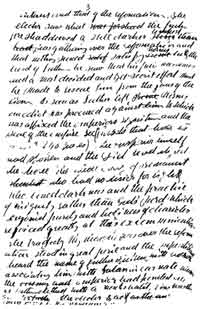
Page 22
Bishop Hall and others; Scott and Benson have enriched their
pages abundantly from Henry; Gill has translated the spirit of Poole's
'Synopsis,' but he most generally gives his authorities; Adam Clarke and
Davidson have been much indebted to all the best critics, though the former
does not always mention his obligations, and the latter never."--The
Condensed Commentary and Family Exposition of the Holy Bible (London:
William Tegg, 1863), Preface, p. iv.
Someone might ask whether Mrs. White's use of the writings
of others imparts an aura of inspiration to those writings thus used. The
answer is that it does not. Truth is truth, and in such use made by an inspired
writer they are but building materials in the prophet's hands.
The next question that might be asked is:
Would it have been possible for some inaccuracy to have crept into Ellen
White's descriptions of historical events or that the historians from whom she
quoted may have been mistaken in some points of detail and thus, Ellen White,
not being especially informed, allowed these mistakes to slip through into her
narrative? Unless we are to claim more for her than we do for the Bible
writers, the answer would have to be in the affirmative, yet this does not
invalidate the inspiration of the prophetic writings. In times of old the
sacred writers, working under the general superintendence of the Holy Spirit,
may have included in their manuscripts as they wrote them what may (by modern
definition) have been discrepancies. But I would emphasize that, while a few
such discrepancies may exist, they in no wise invalidate the inspiration of
God's Word or its overall accuracy and dependability.4.3
Similarly, in the case of Ellen White we can point to some
seeming discrepancies in matters of little conse-
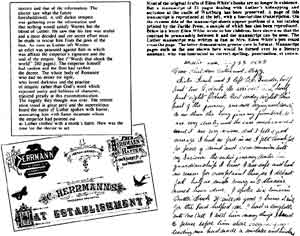
Most of the original drafts of Ellen White's books are no longer in existence.
But a manuscript of 51 pages dealing with Luther's kidnaping and the seclusion
at the castle of Wartbrug has been preserved. A page of this manuscript is
reproduced at the left (above), with a line-for-line transcripts. On the reverse
side of the manuscript sheets appear portions of a hat catalog printed by
pacific press, a sample of which has also been reproduced. Below is a letter
Ellen White wrote to her children, here shown so that the contrast in penmanship
between it and the manuscript can be seen. The Luther manuscript was written
as fast as Mrs Ellen White's pen could cross the page. The letter demonstrates
greater care in format. Manuscript pages such as the one shown here would
be turned over to a literary assistant, who was instructed to correct spelling,
punctuation, et cetera. [Click to
Enlarge]
Page 23
quence. For example, she once wrote, "'The love of Christ
constraineth us,' the apostle Peter declared."--Review and Herald, October 30,
1913. She should, of course, have said "Paul" instead of "Peter." In giving the
account of the St. Bartholomew Massacre in France (see The Great
Controversy, pp. 272, 273), in her first writing published in 1888, she
declared that the ringing of the bell of the palace was the "signal for the
slaughter." When she later learned that historians differed, some saying the
"palace bell," and some saying "the church bell of St. Germain" across the
street, and some the "palace of justice" around the corner, she modified the
wording in 1911 to read, "A bell tolling at dead of night, was a signal for the
slaughter."--The Great
Controversy, p. 272. It was not her intention to attempt to settle fine
points of difference among historians. On this her son, W. C. White, wrote:
"When Controversy was written, Mother never thought that the readers
would take it as authority on historical dates or use it to settle controversy
regarding details of history, and she does not now feel that it should be used
in that way."--W. C. White to W. W. Eastman, Nov. 4, 1912. Quoted in The
Ellen G. White Writings, p. 34.
Up to this point we have been considering Ellen White's
sources for the Conflict books and particularly The Great Controversy.
We have seen how God repeatedly opened up to her in vision the great
controversy story and how she labored to trace the picture on the background of
the history of the past. But the real message of these books is what they mean
to the future--the final outworking of God's plans and purposes.
In the last half of
The Great
Controversy, the volume climaxing the series, we find God's chosen
servants proclaiming the return of our Lord, and we follow the history of God's
remnant church from its inception in the dark hours of disappointment to its
glorious triumph, finally witnessing the coming of the Lord and the rewarding
of all who are faithful. It is a moving story, filled with vital information
and divine guidance for the people living in earth's last days.
"The Holy Spirit traced these truths upon my heart and
mind," she wrote of The Great Controversy, Patriarchs and Prophets, and
The Desire of
Ages, "as indelibly as the law was traced by the finger of God, upon
the tables of stone."--Colporteur Ministry, p. 126.
She also said: "Sister White is not the originator of these
books. They contain the instruction that during her lifework God has been
giving her. They contain the precious, comforting light that God has graciously
given His servant to be given to the world. From their pages this light is to
shine into the hearts of men and women, leading them to the
Saviour."--Ibid., p. 125.
4) All italics used in quotations are
supplied unless otherwise noted.
4.1) Available at your Adventist
Book Center in facsimile reprint.
4.2) Occasionally it has been asked
whether such literary borrowings by Ellen White should not be considered
plagiarism. The accepted practice of historians, and particularly religious
writes of the nineteenth century, indicates that procedures she followed were
common. See Ellen G. White and Her Critics on "Mrs. White's Literary
Borrowings" (pp. 403-467) for a document-supported discussion.
4.3) The British theologian Dr.
Henry Alford, Dean of Canterbury, in his book The New Testament for English
Readers (1865), discusses in a most way "The Inspiration of the Evangelists
and Other New Testament Writers." See Appendix B in The Ellen G. White
Writings.
Page 25
Overwhelmed by the magnitude of the task of writing on the
life of Christ, Ellen White felt keenly her lack of skills. She said, "I will
try, if the Lord will help me, at forty-five years old to become a scholar in
the science [of writing]."
After the publication of The Spirit of Prophecy,
volume 1, in 1870, James and Ellen White turned their attention to a second,
400-page book. This one would deal with New Testament history, the life of
Christ, and the work of the apostles. A third volume, also of 400 pages, would
deal with post-Biblical history, continuing down to the end of time.
January 1, 1873, found James and Ellen White on the West
Coast, where Ellen White began her writing on the life of Christ. In meetings
over the next weekend, held in the Baptist church in Petaluma, she spoke Sunday
morning on the temptation of Christ in the wilderness and felt the "force of
the subject."
However, because at this time her husband, who had
encouraged her in her writing and who often assisted her in preparing materials
for the press, was ill from protracted periods of overwork, she decided a week
later to face the situation candidly. Until she acquired the skills she felt
she needed, she would discontinue her writing on the life of Christ. At the
present time how could she deal with such great and sublime themes? "I am
thinking," she wrote in her diary, "I must lay aside my writing I have taken so
much pleasure in, and see if I cannot become a scholar. I am not a grammarian.
I will try, if the Lord will help me, at forty-five years old to become a
scholar in the science [of writing]. God will help me," she declared. "I
believe He will."--Manuscript 3, 1873, p. 5.
With formal schooling of only three years, she ever felt her
inadequacy in writing. Not long before this she urged upon her children the
importance of learning to be good writers (Letter 28, 1871). Her books, her
articles, and her letters and manuscripts reveal that from the very beginning
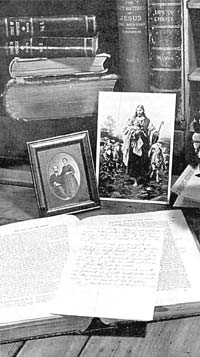
[Click to Enlarge]
of her literary work, her writing was clear and forceful,
and her messages carried a distinctive style. A reading of Early
Writings, written in the earlier years, reveals a modest vocabulary and a
simple sentence structure. Later books and articles disclose a development in
literary skills. This came about as she helped her husband correct proof sheets
for the Review and Herald and the other publications, as she read, and
as she mixed with people day by day at home and in her travels. Constantly, as
do most writers, she turned subjects over in her mind and endeavored to find
the best, most convincing manner to express truth.
Already several articles had appeared in the Review,
beginning with December, 1872, introducing "The First Advent of Christ."
Fortunately, although feeling her inadequacy, she did not give in to her
feelings, but intermittently during the next few years she wrote and
Page 26
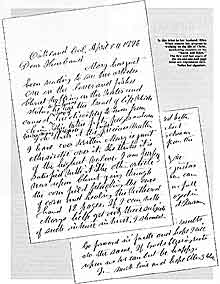
In this letter to her husband, Ellen White reports her progress
in working on the life of Christ,
mentioning chapters on the "loaves and fishes." The first and last pages of
the six-and-one-half-page
letter are reproduced here. Notice her signature. [Click
to Enlarge]
Page 27
published articles on the life and teachings of Jesus. These
closed in April, 1875, with a series on "The Temptation of Christ."
A year later, circumstances were more favorable for writing.
Ellen White was again on the Pacific Coast in her new home in Oakland,
California. She had good literary help in her niece, Mary Clough, a talented
young woman, the daughter of her sister Caroline. Mary was an earnest
Christian, but had not accepted the seventh-day Sabbath. James White was in the
East, attending the General Conference session and caring for other duties as
General Conference president. Seeing an opportunity to get on with her writing
on the life of Christ, Ellen White determined that unless the Lord directed her
otherwise, she would concentrate on this project.
Late in March, she wrote her husband: "Mary Clough and I
will do all we can to forward the work of my writings. I cannot see any light
shining to Michigan for me. This year I feel that my work is writing."--Letter
63, 1876.
"I enjoy the presence of God," she assured James. "I am
writing and having freedom in my writing. Precious subjects I am handling. The
last I completed. . . [was the story of] Jesus healing the impotent man at the
pool of Bethesda."--Letter 1, 1876.
The first drafts of her materials were in Ellen White's own
handwriting. Mary would edit the pages carefully, and put them into the form of
a chapter. Of course, the finished work was also in handwritten form, for it
was six or seven years before typewriters came into use in Mrs. White's work.
Every morning she would write diligently in her upstairs room. After dinner,
she would go to Mary Clough's room, lie on a sofa, and listen as Mary read the
material prepared from her handwritten manuscript. She would rest or ride out
in the carriage in the afternoon, perhaps pen a few letters, and then again in
the evening go to Mary's room to hear more. Because the two women worked so
closely together, Mrs. White even spoke of the writing "we" are doing, meaning
the work she and Mary were doing together. Some years later she explained the
use of the term "we": "My helpers and I are co-workers in sending out the light
given me to be a blessing to the world."--Letter 170, 1906.
Mrs. White felt perfectly confident in both her human and
her divine help: "The precious subjects open to my mind well," she wrote in
early April (Letter 4, 1876).
As the two women worked together with dedicated purpose, it
seems they had at hand for reference several standard works by other authors,
such as William Hanna's Life of Christ, the Life and Work of
Christ, by Cunningham Geikie, and possibly others. The finished product as
published gives evidence that they made some use of Hanna's Life of
Christ.
One day Ellen White reported to her husband: "Mary has just
been reading to me two articles--one on the loaves and fishes, [another on]
Christ walking on the water. . . . This takes fifty pages and comprises many
subjects. I do think it the most precious matter I have ever written. Mary is
just as enthusiastic over it. She thinks it is of the highest value. . . .
"Interesting subjects are continually opening to my mind.
These subjects I speak upon which fastens them in Mary's mind."--Letter 13,
1876. (See illustration on opposite page.)
And, indeed, Mrs. White's public speaking during this period
was also a part of the revelatory process. While working on the chapter on the
feeding of the 5,000, she spoke to a large local congregation, taking up, she
said, "the subject of the loaves and fishes. . . . They all listened with wide
open eyes," she reported, "and some [with] open mouths."--Letter 9, 1876.
Writing to Lucinda Hall, she declared: "I have a special
work at this time to write out the things which the Lord has shown me. .
. . I have a work to do which has been a great burden to my soul. How great, no
one but the Lord knows.
"Again, I want time to have my mind calm and composed. I
want to have time to meditate and pray while engaged in this work. . . . This
is a great work, and I feel like crying to God every day for His Spirit to help
me to do this work all right. "--Letter 59, 1876. (Italics supplied.)
Bible study, visions, prayer, meditation, discussion with
her literary assistant, even "hard thinking," all under the general
superintendence of the Holy Spirit, were involved in the writing. "I feel great
peace and calmness of mind," she noted. "There seems to be nothing to confuse
and distract my mind, and with so much hard thinking my mind could not be
perplexed with anything without being overtaxed. "--Letter 13, 1876.
"I cannot rush business," she wrote. "This work must be done
carefully, slowly, and accurately. The subjects we have prepared are well
gotten up. They please me."--Letter 14, 1876.
When, by the end of May, 1876, Mrs. White's
work on volume 2 of The Spirit of Prophecy,5 carrying the account to the triumphal entry into
Jerusalem, was largely finished, she left California for camp meetings in the
East. By the end of November the book was published, but for some reason it
carried a publication date of 1877.
By way of demonstration, let us look at the chapter on the
loaves and the fishes as published in The Spirit of Prophecy, volume 2,
pp. 258-267, comparing the account with the Gospel writers and with Hanna's
Life of Christ. To Ellen White the Bible was a basic source book.
All four of the Gospels report the experience of feeding the
five thousand (Matt. 14:13-23; Mark 6:32-46; Luke 9:10-17; John 6:1-13). These
inspired accounts Ellen White had before her, as have all who have written on
Christ's life. She began her narrative with the place of retirement where the
event took place--a suitable place
Page 28
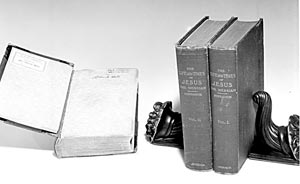
As Ellen White wrote on the life of Christ, she made use
of such works as the Life of Christ, by William Hanna,
and The Life and Times of Jesus the Messiah, by Alfred Ederheim. Her
personal copies, pictured above,
include her signture on the flyleaf, as shown on the Hanna volume. [Click
to Enlarge]
"for such retirement beyond the sea from Capernaum" (The
Spirit of Prophecy, vol. 2, p. 258). Hanna's description may have enriched
the Ellen White account, for, as does Matthew, he writes of "a desert place"
and adds that it was "over against Capernaum, across the lake, in the district
running up northward to Bethsaida" (The Life of Christ, p. 277).
Both Hanna and Ellen White point out two reasons for
Christ's command to the disciples recorded by Luke--"Make them sit down by
fifties in a company" (Luke 9:14). Mark says, "They sat down in ranks, by
More important than the similarities are
the points of differences in the two manuscripts. These clearly demonstrate
nondependence.
hundreds, and by fifties" (chap. 6:40). Hanna
says the order was "indicative of our Lord's design that there might [be] no
confusion and that the attention of all might be directed to what he was about
to do. "--Ibid., p. 279.
Ellen White mentions the same point: "to preserve order,
that all might witness the miracle He was about to do" (The Spirit of
Prophecy, vol. 2, p. 262).
Both Hanna and Ellen White write of the threat of "violence"
which might follow attempts to make Christ king:
Hanna wrote of the apparent intention of the people to "take
him at once, and force him to be their king. Jesus sees the incipient action of
that leaven which, if allowed to work, would lead on to some act of violence.
"--The Life of Christ, p. 280.
Ellen White said, "He knows that violence and insurrection
would be the result of His exaltation as Israel's king."--The Spirit of
Prophecy, vol. 2, p. 264.
What is reported could possibly be inferred from John 6:15,
but there may be a connection with the account in Hanna's book.
Hanna says, "He calls the twelve to him, and directs them to
embark immediately, . . . to row back to Capernaum, where, in the course of the
night or the next morning, he might join them . "--The Life of Christ,
p. 280.
Ellen White reports: "He calls His disciples to Him and
directs them to immediately take the boat and return to Capernaum, leaving Him
to dismiss the people. He promises to meet them that night or on the following
morning. The disciples are loth to submit to this arrangement."--The Spirit
of Prophecy, vol. 2, p. 264.
Similarities in the written accounts of minor points not
mentioned, but possibly implied, by the Gospel writers, occur here and there in
the two works. In the case of a promise to meet the disciples, either that
night or the next morning, we might observe that Hanna made this as a logical
assumption, possibly based on Mark 6:45. Ellen White may have based her
statement on Scripture implication, on information given her in vision, or on
Hanna's assumption. The evidence available precludes any dogmatic conclusion.
More important than the similarities are the points of
differences in the two manuscripts. These clearly demonstrate nondependence.
On the trip across the lake to the "desert place," Ellen
White informs us that "others followed Him over the water in boats."--The
Spirit of Prophecy, vol. 2, p. 259. Neither the Gospel writers nor Hanna
mentions this point.
In The Spirit of Prophecy, volume 2, on pages 259 and
260, Ellen White describes some of the work of the day: "Hundreds of the sick
and maimed had been brought for Jesus to relieve, and were disposed upon the
ground in positions favorable to arrest His attention. . . . All maladies were
represented among the sick who claimed His notice. Some were burning with fever
and unconscious of the anxious friends that ministered to them. There were the
deaf, the blind, the palsied, the lame, and lunatic. . . .
Page 29
"His discourse was often interrupted by the delirious
ravings of some fever-stricken sufferer, or the piercing shriek of the insane,
whose friends were trying to press through the crowd and bear the afflicted to
the Healer. The voice of wisdom was also often lost in shouts of triumph as the
victims of hopeless disease were instantly restored to health and strength."
One of Ellen White's special sources was the Bible, with
its inspired accounts of the life and teachings of Christ
and the glimpses it gives of the controversy from its beginning. [Click
to Enlarge]
Hanna here merely mentions the healing of the sick.
But there is a significant detail mentioned by Ellen White
that neither Hanna nor other writers on the life of Christ mention. This is the
description in The Spirit of Prophecy, volume 2, of the attempt of the
disciples to save Christ from exhaustion: "The Master had labored through all
that time without food or repose, and the disciples, seeing Him pale with
weariness and hunger, besought Him to rest from His toil and take some
refreshment. Their entreaties being of no avail, they consulted together as to
the propriety of forcibly removing Him from the eager multitude, fearing that
He would die of fatigue.
"Peter and John each took an arm of their blessed Master and
kindly endeavored to draw Him away. But He refused to be removed from the
place. His work was imperative; every applicant for His mercy felt his own case
to be the most urgent. The crowd press about the Saviour; they sway Him hither
and thither. In their
efforts to more nearly approach Him, they trample upon each
other."--Pages 260, 261.
Here is specific, detailed information not mentioned by
either the Gospel writers or Hanna. It illustrates the point, that whether
Ellen White gained factual and descriptive information of one kind or another
from Hanna, Geikie, and others, her vision source gave her information of which
other writers on the life of Christ were unaware. Such descriptions have a ring
of authenticity that could be given only by an eyewitness. Her writing is rich
with fresh new items and deals with the lessons and spiritual matters as no
others do.
Both volume 2 of The Spirit of Prophecy series we
have been dealing with, and volume 3, published in 1878, which fills out the
life of Christ, were issued under the general title The Great Controversy
Between Christ and Satan. One carried a subtitle of "Life, Teachings and
Miracles of Our Lord Jesus Christ," and the other "The Death, Resurrection and
Ascension of Our Lord Jesus Christ." Shortly thereafter the major part of the
materials was divided and issued as six pamphlets. It was also published as a
single volume in some of the European languages such as German, French, Danish,
and Swedish under the title of The Life of Chris.
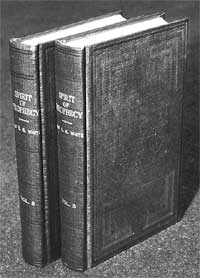
These volumes carrying the title of "Great Controversy"
presented Ellen G. White account of Christ's life and ministry.
[Click To Enlarge]
5) Available in facsimile reprint from
Adventist Book Centers.
Page 30
Preparing "THE DESIRE OF
AGES"
Literary assistants played an important role in preparing
the Conflict Series,
but the books remained the product of Ellen White's
mind guided by the Holy Spirit.
The
Desire of Ages is acclaimed by many as the crowning literary production
of Ellen White's pen, because of its style, language, and spiritual power. She
herself disclosed the principal reasons for this when she declared in 1895:
"You know that my whole theme both in the pulpit and in private, by voice and
pen, is the life of Christ."--Letter 41, 1895.
Ever striving for excellence in speaking and writing on the
sublime themes of the life and ministry of our Saviour was bound to result in
paramount work.
Diligent work on the manuscript for The Desire of
Ages stretched over a period of six years, 1892-1897. The book followed
naturally the publication of
The Great
Controversy in 1888 and
Patriarchs and
Prophets in 1890. But not until Ellen White moved to Australia was she
able to find time for more than the barest attempt on this large literary
project, a project that would yield not only
The Desire of
Ages but Thoughts From the Mount of
Blessing and Christ's Object Lessons and Christ's Object
Lessons, as well.
Work on this book did not call for writing of completely new
manuscripts, beginning with chapter one and running through to the end, but a
work of bringing together, enlarging, and amplifying that which had gone before
in The Spirit of Prophecy, periodical articles, manuscripts, and
letters. It would have been an unpardonable misuse of resources to have ignored
the extensive writing done by Ellen White up to this time on the life and
ministry of Jesus.
But, with her many responsibilities, including travel, speaking
appointments, counseling, and the constant writing of testimonies, Ellen White
had little time to bring together and arrange existing materials to form the
basic pattern of the enlarged work on the life of Christ. This was largely a
clerical task another could perform. This responsibility she placed upon Marian
Davis, who
The Granville home near Sydney, Australia, where Ellen White
and her staff worked
from June, 1894, trhough 1895 preparing the Desire of Ages manuscript. [Click
to Enlarge]
since 1879 had been one of her literary assistants. Miss
Davis was an efficient, dedicated worker. In 1900 Mrs. White wrote of Marian:
"She is my book-maker. . . .
"How are my books made? ... She [Marian] does her work in
this way. She takes my articles which are published in the papers, and pastes
them in blank books. She also has a copy of all the letters I write. In
preparing a chapter for a book, Marian remembers that I have written something
on that special point, which may make the matter more forcible. She begins to
search for this, and if when she finds it, she sees that it will make the
chapter more clear, she adds it.
"The books are not Marian's productions, but my own,
gathered from all my writings. Marian has a large field from which to draw, and
her ability to arrange the matter is of great value to me. It saves my poring
over a mass of matter, which I have no time to do."--Letter 61a, 1900.
In the preparation of
The Desire of
Ages, after selections from the published materials relating to a
particular phase of the Saviour's ministry were assembled, and selections from
unpublished manuscripts were added, both Ellen White and Miss Davis gave
diligent study as to how well what had been written covered the subject and how
much Ellen White still wished to add.
Then as the work progressed, each doing her part, Miss Davis
would search the writings for additional material, and Ellen White would fill
in the gaps. In this way the chapters were rounded out. But Ellen White alone
performed the task of filling in to complete the text. She made mention of this
at the death of Marian Davis in 1904, when her mind turned back to their labors
together. "We have stood side by side in the work, and in perfect harmony in
that work. And when she would be gathering up the precious jots and tittles
that had come in
Page 31
papers and books and present it to me, 'Now,' she would say,
'there is something wanted [lacking]. I can not supply it.'"I would look it
over, and in one moment I could trace the line right out. We worked together,
just worked together in perfect harmony all the time. "--Manuscript 95, 1904.
Miss Davis gives us a glimpse of her task early in the work
as she pleaded that relevant materials be copied out from various sources, so
they would be more readily available: "Perhaps you can imagine the difficulties
of trying to bring together points relating to any subject, when these must be
gleaned from thirty scrapbooks, a half dozen bound [E. G. White] volumes, and
fifty manuscripts, all covering thousands of pages."--Marian Davis to W. C.
White, March 29, 1893.
Some time earlier in their work together Ellen White had
felt that Marian needed to be a little less dependent in certain phases of her
work. It seems that she wanted Ellen White and her son, W. C. White, to see
"every little change of a word" that she made. "Her mind," Ellen White
declared, "is on every point and the connections," so she had a little talk
with Marian, and explained that "she must settle many things herself," that
"she must carry some of these things that belong to her part of the work"
(Letter 64a, 1889).
In 1893 the newly opened Bible training school, not far from
the Belden home in Melbourne, Australia, where Miss Davis was rooming, offered
a course in the life of Christ. Eager to get all the background help she could
for her task on the E. G. White manuscript on Christ's life, she enrolled in
early 1893.
She wrote to Ellen White, who was spending most of the year
in New Zealand, "The Bible class coming in the middle of the forenoon is rather
inconvenient, but while the life of Christ is studied, I can't afford to lose
it." And she added, "It is the only thing I have bearing on my work, and it
wakes one's mind up, to hear the matter talked over."--Marian Davis to Ellen G.
White, October 18, 1893.
The interchange of correspondence during this year showed
the concern of each of the two women as they made progress in the preparation
of the manuscript. In July Ellen White reported, "I write some every day on the
life of Christ."--Letter 132, 1893.
Addressing Mrs. White in early August, Marian Davis wrote,
"Now about the book. I am so glad you are writing on the two journeys to
Galilee. I was so afraid you would not bring that out. . . . I shall watch with
great interest for the arrival of the promised manuscript. . . . There is such
a rich field in the teachings of Christ after He left Jerusalem."--Marian Davis
to Ellen G. White, Aug. 2, 1893.
Some time earlier, prompted possibly by her attending the
class, Marian Davis suggested some topics she thought she would like to see
represented in the book.
In preparing her books Ellen White would also draw from her
articles that had already appeared in journals.
One of her helpers, Marian Davis, kept scrapbooks similar to the one pictured
here, containing Ellen White's
1885 Review articles that dealt with the life of Christ. [Click
to See Original]
Ellen White did not see the real need, and declared, "These
I shall not enter upon without the Lord's Spirit seems to lead me." She
continued: "The building a tower, the war of kings, these things do not burden
my mind, but the subjects of the life of Christ, His character representing the
Father, the parables essential for us all to understand and practice the
lessons contained in them, I shall dwell upon."--Letter 131, 1893.
When Ellen White returned from New Zealand to her Melbourne
home she referred to the book in preparation in a letter to the president of
the General Conference in 1894, bemoaning:
"If I could only feel to give my whole attention to the
work. . . . And now I think, as I have thought a few hundred times, I shall be
able after this [American] mail closes to take the life of Christ and go ahead
with it, if the Lord will. "--Letter 55, 1894.
But perhaps of greater concern to her was the importance of
an adequate portrayal of Christ's life and ministry. As she undertook work on
the manuscript soon after her arrival in Australia, she wrote: "This week I
have been enabled to commence writing on the life of Christ. Oh how
inefficient, how incapable I am of expressing the things which burn my soul in
reference to the mission of Christ! I have hardly dared to enter upon the work.
There is so much to it all. And what shall I say, and what shall I leave
unsaid? I lay awake nights pleading with the Lord for the Holy Spirit to come
upon me, to abide upon me. "--Letter 40, 1892.
Disclosing her heart feelings she continued: "I walk with
trembling before God. I know not how to speak or trace with pen the large
subjects of the atoning sacrifice. I know not how to present subjects in the
living power in which they stand before me. I tremble for fear lest I shall
Page 32
belittle the great plan of salvation by cheap words. I bow
my soul in awe and reverence before God and say, Who is sufficient for these
things?"--Ibid., quoted in Ellen G. White, Messenger to the
Remnant, p. 59.
Some months later, in a letter written to the president of
Battle Creek College, she made a statement others would not agree with, but
which expressed her feelings: "Now I must leave this subject so imperfectly
presented, that I fear you will misinterpret that which I feel so anxious to
make plain. Oh that God would quicken the understanding, for I am but a poor
writer, and cannot with pen or voice express the great and deep mysteries of
God."--Letter 67, 1894.
As the materials were assembled and arranged into chapters,
careful attention had to be given to the sequence of the events in the
Saviour's life. To what extent and in what detail visions provided the sequence
in ministry and miracles in Christ's life and work is not known to us. We do
know that a decade earlier she made a significant request: "Tell Mary to find
me some histories of the Bible that would give me the order of events.
"--Letter 38, 1885. The reason for this is that she could find nothing in the
publishing house library in Basel, Switzerland.
Marian had a mass of material before her on one phase or
another of Christ's life, and in the main it was her task to put the materials
into proper sequence. The Gospel writers in their accounts did not help her
much. In the absence of direct instruction from Ellen White, or clues in the
materials themselves, Miss Davis consulted carefully prepared harmonies of the
Gospels.
As the work was nearing completion, Marian, working on the
three introductory chapters, "'God With Us,'" "The Chosen People," and "'The
Fullness of the Time,'" sought the counsel of Elder Herbert Camden Lacey, Bible
teacher at the Avondale School, concerning the arrangement of the paragraphs.
He made some helpful suggestions on this line, which, when it became known,
gave birth to rumors that Lacey had a prominent role in authoring the book. In
oral and written statements Elder Lacey flatly denied this rumor. One such
statement explaining his involvement in the preparation of The Desire of
Ages reads: "Miss Marian Davis, who was entrusted with the preparation of
'Desire of Ages,' frequently came to me in 1895 and 1896 asking help in the
arrangement of the material which she gathered from Sister White's various
manuscripts. Sister Davis was a warm personal friend of mine, and I did the
best I knew how to aid her, especially in the first chapter. As I recall it,
this help was only in the arrangement of the sentences, or paragraphs, or the
choice of a more suitable word. Never at any time, was there any alteration of
the thought, or the insertion of an idea that was not already expressed in the
original text. The resultant 'copy' was always submitted to Sister White
herself for final approval.
"The entire 'Desire of Ages' as it is now printed is,
therefore, I hold, the product of Sister White's mind and heart, guided by the
good Spirit of God. And the 'editing' was merely technical.
"I gladly and with all my heart accept the 'Desire of Ages'
as an inspired book; indeed I regard it as the most spiritual Life of Christ,
outside the Gospels, ever given to His Church."--H. C. Lacey to S. Kaplan, July
24, 1936, White Estate Document File 508.
Ellen White did not choose the titles for her books, except
possibly those for The Great Controversy and the Testimonies.
This usually was a matter of collaboration between Ellen White, her literary
assistants, and her publishers. In this case, the publishers suggested two
possible titles, "The Desire of All Nations," and "The Desire of Ages," both
based on Haggai 2:7, "The desire of all nations shall come." "The Desire of
Ages" was favored.
As to chapter titles, these came rather naturally as the
material was prepared, being representative of the subject matter. The Bible
narrative naturally suggests some, but there is some paralleling with chapter
titles used by others in writing on Christ's life. Selection would be based on
appropriateness and reader appeal.
As she pushed ahead in preparing
The Desire of
Ages, Ellen White was not ignorant of the help certain narratives on
the life of Christ and works depicting Bible geography and customs could be to
her in the descriptive part of her writing. William Hanna's Life of
Christ, to which reference had been made in 1876, and Cunningham Geikie's
Life and Work of Christ were in her library, and no doubt others. At
various times she and her son, W. C. White, demonstrated their acquaintance
with such works. Thus, for instance, just as she left Oakland for Battle Creek
in 1876, apparently anticipating that she would be finishing The Spirit of
Prophecy, volume 2, and would be continuing on volume 3, she selected books
to be sent to her. On the train she wrote a note home: "You need not send
[Daniel March's] Walks and Homes of Jesus when you send the books I laid
out."--Letter 27a, 1876.
While in Europe in 1887, W. C. White recommended to the
publishing house there that they purchase William Hanna's Life of
Christ, Geikie's Hours With the Bible, S. J. Andrews' Life of Our
Lord, and Edersheim's works on the Temple and its services and Jewish
social life. He also advised them to secure a good harmony of the Gospels.
All of these books on the life of Christ were quite well
known in Adventist circles.
Page 33
Because the works of Hanna and certain others dealt with the
scenes that had passed before her in vision, Ellen White found these sources
helpful. But these materials did not constitute the basic sources for her
information on Christ's life and teaching.
To Ellen White the preparation of
The Desire of
Ages was an awesome challenge. The scenes were so sublime, the
sacrifice was so great, that depicting the story took hold of every fiber of
her being. Of this she wrote: "In writing upon the Life of Christ I am deeply
wrought upon. I forget to breathe as I should. I cannot endure the intensity of
feeling that comes over me as I think of what Christ has suffered in our
world."--Manuscript 70, 1897.
Day and night, as she labored on this task, she sensed the
tremendous responsibility of capturing and presenting in an effective way and
in adequate language the vivid scenes and important lessons of Christ's life
and ministry.
Some years earlier she had written of how "the betrayal,
trial, and crucifixion of Jesus" had passed before her "point by point" (Letter
14, 1889). Taking up work on The Desire of Ages in 1892, she mentioned
that, as she wrote, the subjects stood before her in "living power" (Letter 40,
1892).
Most likely what she wrote in 1911 of her work on the
preparation of the manuscript for The Great Controversy was also true of
The Desire of Ages: "I was often conscious of the presence of the angels
of God. And many times the scenes about which I was writing were presented to
me anew in visions of the night, so that they were fresh and vivid in my
mind."--Letter 56, 1911.
It seems clear that the visions given down through the years
in which the life of Christ was portrayed and the visions repeated while she
was working on the manuscript for
The Desire of
Ages and visions opening up fresh concepts all came into play as basic
sources of her writing on the life of Christ.
As she was preparing The Desire of Ages in the
1890's, apparently at times she consulted the standard works on the life of
Christ, some of which were in her library. However, it is obvious that these
materials did not constitute the basic source of her information on Christ's
life and teaching, or of the deeper insights, or of many of the deeply
spiritual lessons she drew from the teachings of Christ. Nevertheless she found
the works of Hanna, Edersheim, Farrar, Geikie, and certain others that dealt
with the scenes that had passed before her in vision helpful. In them she may
have found a graphic way of presenting truth, but this does not mean that such
was her basic source. Her insights and spiritual lessons frequently go far
beyond the presentations in these writings.
In last week's article I showed the similarities and
differences between certain expressions employed by Hanna and by Ellen White as
she wrote in 1876 on the feeding of the five thousand. It is quite clear that
20 years later, as she worked on the same subject for The Desire of Ages
presentation, she again found in Hanna
Next page: One of the edited pages of The Desire of Ages manuscript
is shown in the form in which it was sent to the publisher, The Pacific Press,
in Oakland, California. The editorial marks, made in Ellen White's office in
Australia, carried Mrs. White's full approval.
Page 34
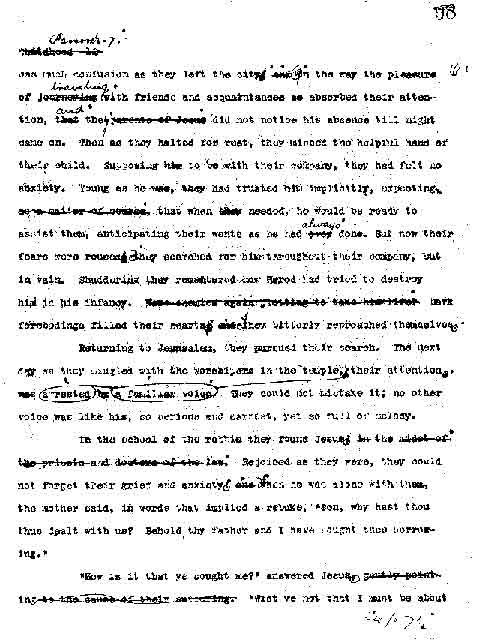
Page 35
At the home she called "Sunnyside," near the Avondale school
in Australia,
Ellen G. White completed her work on the Desire of Ages in early
1898.
[Click to Enlarge]
and Geikie descriptions that were useful in setting forth
the inspired picture.
Thus, for instance, Ellen White in
The Desire of
Ages states that when Christ charged the disciples to take the ship and
return to Capernaum, they "had not put off immediately from the land, as Jesus
directed them. They waited for a time, hoping that He would come to them. But
as they saw that darkness was fast gathering, they 'entered into a ship, and
went over the sea toward Capernaum.' "--Pages 379, 380.
As Geikie reconstructs the story, he says, "At the first
signs of tumult among the people, He had sent off the Twelve to cross the Lake
again at once, to the Bethsaida near Capernaum, while He dismissed the
multitudes. They had waited for Him till night fell, but, at last, as He did
not come, they set off without Him. "--The Life and Words of Christ,
vol. 2, p. 188.
In connection with what followed, what does Ellen White say
that the Gospel writers and narrators do not say? Let us first note what Hanna
says about the evening hours Jesus spent on the mountain: "Alone He goes up
into a mountain--alone He prays there. . . . Till after dawn Jesus holds secret
and close fellowship with heaven. Into the privacies of those secluded hours of
His devotion we presume not to intrude."--Life of Christ, p. 128.
Matthew says simply, "He went up into a mountain apart to
pray" (Matt. 14:23). Mark, Luke, and John add nothing.
In The Desire of Ages, page 379, Ellen White tells us
what Hanna intimates he did not know--the burden of Christ's prayer: "When left
alone, Jesus 'went up into a mountain apart to pray.' For hours He continued
pleading with God. Not for Himself but for men were those prayers. He prayed
for power to reveal to men the divine character of His mission, that Satan
might not blind their understanding and pervert their judgment. . . . In
travail and conflict of soul He prayed for His disciples. They were to be
grievously tried. Their long-cherished hopes, based on a popular delusion, were
to be disappointed in a most painful and humiliating manner. . . . For them the
burden was heavy upon His heart, and He poured out His supplications with
bitter agony and tears."
Consider another illustration. Of the Gospel writers only
Mark introduces the proposition that Jesus and His disciples should retire to
some quiet place to gain some rest. He writes, "He [Jesus] said unto them, Come
ye yourselves apart into a desert place, and rest a while" (Mark 6:31).
Quoting Mark, Hanna tells of how "Jesus desired now a little
quiet and seclusion. For Himself--that He might ponder over a death [of John
the Baptist] prophetic of His own. . . . For them [the disciples] that they
might have some respite from accumulated fatigue and toil. His own
Page 36
purpose fixed, He invited them to join Him in its execution,
saying to them, 'Come ye yourselves and rest awhile.' "--Life of Christ,
p. 277.
While Ellen White in her 1876 writing merely mentions the
invitation, in The
Desire of Ages account she devotes a five-page chapter, titled "Come
Rest Awhile," to the experience, and explains the purpose of the rest
anticipated and of its meaning to us (pages 359-363).
Each of the Gospel writers devotes a few verses to the
invitation, the events of the day, the feeding of the five thousand, and the
dismissal of the people. Hanna devotes four and a half pages, Geikie four. In
The Desire of Ages, Ellen White uses 16 pages in narrating the events
and the lessons (pp. 359-379). Hers is replete with practical instruction,
spiritual lessons, and counsel for the present, a great deal of which goes
beyond the Bible presentation.
Another example: It has been observed that Ellen White's
description of how inanimate nature, the sea, the sun, the rocks, the graves,
bore witness to Christ's divinity, while the priests and rulers knew Him not as
the Son of God, parallels quite closely a quotation Hanna uses from St.
Gregory. But the parallel ends there. Hanna is at a loss to explain what
happened to the dead who rose from the graves opened at Christ's death. He is
uncertain whether they were raised when the graves were opened or later.
Not so Ellen White, who in positive terms declares: "As
Christ arose, He brought from the grave a multitude of captives. The earthquake
at His death had rent open their graves, and when He arose, they came forth
with Him. They were those who had been colaborers with God, and who at the cost
of their lives had borne testimony to the truth. . . .
"Those who came forth from the grave at Christ's
resurrection were raised to everlasting life. They ascended with Him as
trophies of His victory over death and the grave."--The Desire of Ages,
p. 786.
In dealing with the thief on the cross Hanna refers to the
thief's overhearing the conversation of those about the cross as providing
evidence that Jesus is the Lord, and conjectures that it would be unreasonable
to suppose that the thief had not met Jesus before the crucifixion day (Life
of Christ, p. 717).
Ellen White in The Desire of Ages unequivocally
declares that "he had seen and heard Jesus, and had been convicted by His
teaching, but he had been turned away from Him by the priests and rulers.
Seeking to stifle conviction, he had plunged deeper and deeper into sin, until
he was arrested, tried as a criminal, and condemned to die on the cross.
"--Page 749.
It may also be observed that Hanna experiences considerable
difficulty in explaining just what the "paradise" is to which Christ refers
when He declared, "To day shalt thou be with me in paradise" (pp. 721, 722) .
He concludes that Paradise is wherever Jesus is.
"Elmshaven," Mrs White's home located below the St helena Sanitarium
in northern California,
1900-1915. Mrs White is seen in the wheelchair on the second-floor porch. [Click
to Enlarge]
While the preparation of The Desire of Ages ,
Thoughts From the Mount
of Blessing and Christ's Object
Lessons completed her work on the life of Christ, her work on the
controversy story was not complete. As she was able after returning to the
United States, she prepared
The Acts of the
Apostles and Prophets and
Kings, working in this home.
Page 37
Regarding
The Desire of
Ages and the other Conflict books extant in 1906, Ellen White said,
"The Holy Spirit traced these truths upon my heart and mind as indelibly as the
law was traced by the finger of God, upon the tables of stone."
One significant feature in books Ellen White designed for
the general public is that in them, at times, she withheld interesting
information that Seventh-day Adventists, with their understanding of Ellen
White's work, could grasp and accept, but which non-Adventists might have
difficulty accepting. Such information had often appeared in her early books
and periodical articles. For example, in the 1876 book, Spirit of
Prophecy, volume 2, on page 260, appears the account of Peter and John each
taking an arm of the Saviour to lead Him away from the multitude (see page 29).
No mention of this is found in The Desire of Ages.
Marian Davis explains the reason for leaving out this type
of information: "Since these books are sent out
Anticipating a large sale to the general public, Pacific
Press first published
The Desire of Ages in a large, well-illustrated
volume of 835 pages in 1898.
[Click to Enlarge]
without explanation as to the authority by which the author
speaks, it was thought best to avoid, as far as we could, statements for which
the Bible seems to furnish no proof, or which to the ordinary reader appear to
contradict the Bible. Better to give the reader what they will accept and
profit by than to excite criticism and questioning that will lead them to
discredit the whole. . . .
"Sister White says that Christ was twice crowned with
thorns, but as the Bible mentions only the second crowning, it was thought best
to omit the first, or rather to give the second instead of the first."--Marian
Davis to J. E. White, Dec. 22, 1895.
Nonetheless, The Desire of Ages is replete with
extra-Biblical information, generally of a nature that would not prejudice the
uninformed reader.
Neither Hanna nor Edersheim includes in his narrative the
story of the woman taken in adultery, recorded in John 8:1-11. They apparently
accepted the opinion of some scholars, who, finding the account missing in
certain manuscripts, assumed that it was spurious. However, in his narrative
Geikie speaks of the "trembling prisoner" (Life and Words of Christ, p. 297).
Ellen White speaks of "the trembling victim" (The Desire of Ages, p.
461). Geikie recounts the story, unfolding and emphasizing the legal aspects,
and declares, "It was not their business, but that of her husband, to accuse
her," and he conjectures at length what Christ may have written with His finger
in the sand--"most likely the very words He was presently to utter"--and
shortly closes the account with the words "This incident past, . . ." (Life
and Words of Christ, pp. 296-298).
In The Desire of
Ages, Ellen White also mentions that "it was the husband's duty to take
action against her," but dwells at some length on just what Christ wrote with
His finger in the dust: "There, traced before them, were the guilty secrets of
their own lives. The people, looking
To provide an inexpensive version for Adventist consuptions,
The Desire of Ages was published in this small single volume
containing
1,042 smaller pages, in 1898.
[Click to Enlarge]
on, saw the sudden change of expression, and pressed forward
to discover what it was that they were regarding with such astonishment and
shame."--Page 461. The accusers then departed "speechless and confounded"
(ibid., p. 462).
While Geikie dismisses the story at this point, Ellen White
informs us that for the woman "this was to her the beginning of a new life, a
life of purity and peace, devoted to the service of God. . . . This penitent
woman became one of His most steadfast followers. With self-sacrificing love
and devotion she repaid His forgiving mercy. "-- Ibid.
This is followed by two paragraphs of spiritual lessons. The
1876 Spirit of Prophecy, volume 2, account on page 352 dwells at length
on her later life and states that "she stood sorrow-stricken at the foot of the
cross."
In dealing with the resurrection of our Lord, Hanna barely
touches the event itself, linking it with a long discussion on the women coming
to the tomb to anoint the Lord and finding it empty. He writes, "It is as they
are communing with one another by the way, that the earth quakes, and the angel
descends from heaven, and
Page 38
rolls the stone back from the door of the sepulchre, and,
having done this service for the embalmers, sits down upon it, waiting their
approach."-- Life of Christ, p. 780. And then he asks, "Was it then that
the great event of the morning took place?... It is not said so. . . . The
angel himself may not have witnessed the resurrection. He did not say he
had."--Ibid., pp. 780, 781.
Hanna then affirms, "Altogether secret, the exact time and
manner of the event unnoticed and unknown was the great rising from the dead
.... Some time between sunset of the last and sunrise of the first day of the
week, the resurrection had taken place."--Ibid., p. 781.
Geikie says even less, doing little more than quoting from
Matthew 28:1-3.
While commenting briefly on the events, as noted in
Scripture, Edersheim assumes that the stone was rolled away "after the
resurrection of Christ" (Life and Times of Jesus the Messiah, vol. 2, p.
632).
In his Life of Christ Farrar makes an allusion to the
events of that morning in a singular and indirect way: "It became known then,
or afterwards, that some dazzling angelic vision in white robes had terrified
the keepers of the tomb, and had rolled away the stone from the tomb amid the
shocks of earthquake. "--Page 670.
How different is Ellen White's dramatic description of the
resurrection in The Desire of Ages (pp. 779-787). In contrast to the
tentative and inconclusive treatment of the well-accepted writers on the life
of Christ, we have her vivid descriptions of the bands of good and evil angels
watching over the tomb through the night; the angel descending "with the
panoply of God," joining the angel at the tomb; the earthquake; the terror of
the Roman soldiers; the stone removed by the angel as if it were a pebble; the
command of the angel, "Son of God, come forth; Thy Father calls Thee"; Jesus
coming forth in majesty and glory, the Roman soldiers who had fainted at sight
of the angels and the risen Saviour, staggering as drunken men, hurrying to the
city, telling the great news to everyone they met; the soldiers with
blood-drained faces testifying before Caiaphas and Pilate; Caiaphas stunned,
attempting to speak, moving his lips, "but they uttered no sound." It is all
there in The Desire of Ages, as Ellen White had witnessed it in vision,
point by point. How strikingly different from the "sources" she may have
consulted!
Space forbids introducing other illustrations indicating
that whatever use Ellen White made of Hanna or Geikie, et cetera, these did not
take the place of her earliest and continued vision sources.
And as to sources, it might be well to examine the records
left by the Gospel writers. As he introduces his book, Luke declares that he is
a compiler of information set forth by many, and since he "had perfect
understanding of all things from the very first," he felt qualified to do this
(Luke 1:1-3). Ellen White informs us that "Nicodemus related to John the story
of" the interview
In 1900, The Desire of Ages was published in two large,
beautifully illustrated volumes with an aggregate of 835
pages of text for distribution to the general public.
[Click to Enlarge]
he had by night with Jesus, "and by his pen it was recorded
for the instruction of millions" (The Desire of Ages, p. 177).
Ellen White writes with clarity, smoothness, authority, and,
most of all, very feelingly, ever elevating the love, character, and triumph of
Christ as a contender in the great-controversy story. She writes as one who was
an onlooker, as indeed she was, as in vision the scenes passed before her. If
she gained knowledge of some details of the customs of the people, and of the
geographical features of the scenes she portrayed, from careful students of
these matters, does this make her message less inspired? By no means. Those who
hold to a dictational inspiration might feel that such incidental use of what
another has written could not be accepted. But a more factual concept of
inspiration allows for such usage without detracting from the convincing
evidences of divine origin.
By mid-July, 1896, Ellen White felt that the work on the
book was about completed. "The manuscript for the 'Life of Christ,'" she wrote,
"is just about to be sent to America. This will be handled by the Pacific
Press" (Letter 114, 1896). But it seems she was overly optimistic, as authors
often are. In the case of The Desire of
Ages, there were good reasons, for when she thought certain chapters
were finished, in the night season further light would be given that led her to
write more on the subject. This work of writing new material continued into
1898.
The manuscript for the book was sent piecemeal to the
Pacific Press, and even after some chapters had been dispatched, her continued
writing led to amplifications, and these were sent posthaste across the Pacific
to the publishers.
A year before The Desire of Ages came from the press,
Thoughts From the Mount of Blessing was published, and her work on the
parables--Christ's Object Lessons--continued for a year or two after
The Desire of
Page 39
Ages was published. Those being parts of her
presentation on the life and teachings of Jesus, the same procedures were
followed in preparing the manuscript as were employed in
The Desire of
Ages.
Two more books were needed to complete the narrative of the
great-controversy story-- Prophets and
Kings and The
Acts of the Apostles. These in time were ready, the work in preparation
of the manuscripts being done somewhat as it had been on the large volumes
prepared for the world and the church.
In this series of articles, going into the very heart of
Ellen White's work in narrating the great-controversy struggle, we have told
the simple story, supporting it with documentation. The series has been an
interesting study of inspiration and how God's messenger did her work in
depicting the conflict theme in book form. In so doing we may have raised
questions in some minds. If we find our faith tested a bit by discovering new
aspects of how inspired writers work, perhaps we should ask ourselves: Do we
demand more of Ellen White than we demand of the Bible prophets? Or more than
we are justified of demanding of any prophet?
Let us remember that "God does not propose to remove all
occasion for unbelief. He gives evidence, which must be carefully investigated
with a humble mind and a teachable spirit, and all should decide from the
weight of evidence." "God gives sufficient evidence for the candid mind to
believe; but he who turns from the weight of evidence because there are a few
things which he cannot make plain to his finite understanding will be left in
the cold, chilling atmosphere of unbelief and questioning doubts, and will make
shipwreck of faith."--Testimonies, vol. 5, pp. 675, 676.
What is the weight of evidence as we read Ellen White's
books? We urge all to look at the content, the message, the light and counsel
they contain, the encouragement and the timely warnings and their harmony with
Scripture. What have these writings meant to the church down through the years?
Looking back in 1906, Ellen White freely attributed the
truths set forth in the books tracing the great-controversy story, to the
workings of the Holy Spirit. She asked: "How many have read carefully
Patriarchs and Prophets, The Great Controversy, and The Desire of
Ages ? I wish all to understand that my confidence in the light that God
has given stands firm, because I know that the Holy Spirit's power magnified
the truth and made it honorable, saying: 'This is the way, walk ye in it.' In
my books, the truth is stated, barricaded by a 'Thus saith the Lord.'
"The Holy Spirit traced these truths upon my heart and mind
as indelibly as the law was traced by the finger of God, upon the tables of
stone, which are now in the ark, to be brought forth in that great day when
sentence will be pronounced against every evil, seducing science produced by
the father of lies."--Letter 90, 1906; Colporteur Ministry, p. 126.
Although the writing of the books on the agelong conflict
was a vital and important part of Ellen White's work, occupying her attention
through most of her active life, it was by no means the principal part of her
writing. Whereas the Conflict Series is embodied in 3,500 pages of text, nearly
5,000 pages are given to the nine volumes of the Testimonies written
during the same period. Added to this are the many books of counsel, several
thousand periodical articles, and hundreds of personal testimonies. We cannot
here review this major part of her work as the messenger of God presenting His
messages to men and women of the remnant church, laity, and institutional and
church leaders.
In this broader field of writing, from which there seemed to
be no respite, she was impelled to bear testimony to what was revealed to her
in scores and hundreds of visions through 70 years of her ministry. In writing
these messages of instruction, counsel, encouragement, and correction, she
sought no human source of information and was not influenced by those about
her. In all of her work we see her moving under the bidding and guidance of the
Spirit of God.
In writing these articles I have been candid, sincere, and
open in describing how Ellen White did her work in presenting the
great-controversy story to the church and the world. I have written from
personal knowledge. My confidence in the heavenly source of the messages the
Ellen G. White books portray has grown throughout my 50 years of intimate
acquaintance with the Ellen G. White records and my work with them.
This confidence was also nurtured by the years of close
association with my father, W. C. White, under whom I served in the office for
nine years before his death in 1937. He in turn had assisted his mother, Ellen
White, in an active way from the death of his father, James White, in 1881,
until the end of Ellen White's life in 1915. No one had a better opportunity
than he to observe, examine, and understand the manner in which Ellen White
wrote her books, and I have implicit confidence in the reliability of his
testimony. Accordingly I have quoted him in a number of instances.
With the abundance of positive evidence with which I am
acquainted, and the mounting evidence that I from day to day encounter as I
write a definitive biography of Ellen G. White, there is no room for anything
but the strongest confidence that she was indeed the chosen messenger of the
Lord, and that her messages were the counsel, instruction, and information God
wanted her to impart to His remnant church. Knowing as I do the importance of a
clear-cut, factual concept of the operation of inspiration, it has been a
privilege to convey to readers of the REVIEW this information. I believe that
these articles, intimately portraying how Ellen White wrote the Conflict of the
Ages books, furnish a dimension for confidence in God's special gift to His
church at a time when the great adversary is seeking to undermine such
confidence.